厾
Character Story & Explanation
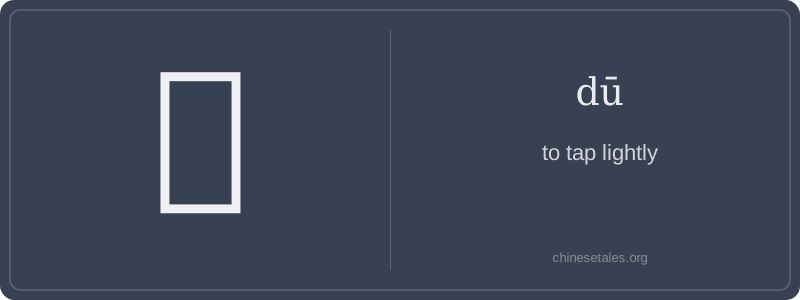
The earliest form of 厾 appears in bronze inscriptions (c. 1000 BCE) as a stylized depiction of a hand (the top component, later evolving into the radical 手) reaching down toward a small, rounded object — possibly a drumhead or a stone surface — with three short diagonal strokes beneath representing the light, repeated impact. Over centuries, the hand simplified into the modern top stroke, the target became abstracted into the lower part, and the three taps coalesced into the distinctive triple-dot base — not random dots, but deliberate, minimal strokes echoing the rhythm of tapping.
This visual logic held firm through the Han dynasty: the character appeared in the Shuōwén Jiězì (121 CE) as ‘to strike lightly with the hand’, citing its use in ritual contexts — e.g., tapping a bronze bell before chanting to ‘awaken resonance without disturbing silence’. In Tang poetry, Du Fu used it metaphorically: ‘厾松闻鹤唳’ (tapping the pine, hearing the crane’s cry) — suggesting a subtle, harmonious interaction with nature. Even today, calligraphers note that the three dots must be written quickly and evenly, mirroring the very action they depict: light, controlled, and never heavy.
Think of 厾 (dū) as the Chinese equivalent of the gentle 'tap-tap-tap' you make with a pencil on your desk while thinking — not a bang, not a knock, but a soft, rhythmic, almost contemplative tap. It’s not about force or urgency; it’s about light contact, often with fingers, a stick, or even a foot — and crucially, it implies intentionality and control. Unlike English ‘tap’, which can be accidental (‘my phone tapped against my leg’), 厾 always carries a sense of purpose: to signal, test, nudge attention, or gently probe.
Grammatically, 厾 is almost exclusively used as a verb in classical or literary contexts — you’ll rarely hear it in daily Mandarin conversation today. It appears most often in compound verbs like 厾打 (dū dǎ) or standalone in poetic or historical texts: ‘他厾了三下门’ (He tapped the door three times). Note: it’s *not* used as a noun (no ‘a dū’), nor does it take aspect particles like 了 or 过 easily — learners mistakenly add them, but native usage keeps it bare and crisp, like the sound itself.
Culturally, 厾 evokes refined restraint — the kind of gesture you’d see in Ming-dynasty ink paintings where a scholar taps his brush handle thoughtfully, or in opera where a performer lightly taps their sleeve to mark a pause. Modern learners often misread it as a variant of 都 (dōu) due to visual similarity in cursive script, or confuse it with 打 (dǎ) — but 厾 is quieter, more delicate, and far rarer. Its near-absence from spoken language makes it a linguistic fossil: beautiful, precise, and quietly demanding respect.