厹
Character Story & Explanation
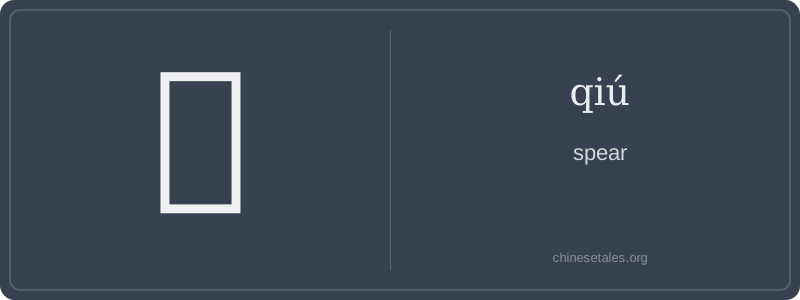
The earliest form of 厹 appears in late Shang oracle bone inscriptions as a vivid pictograph: a vertical line (the shaft), topped by two sharply angled, diverging lines resembling a double-edged, leaf-shaped bronze spearhead — sometimes even with a small crossbar hinting at the socket where blade met wood. Over centuries, the top elements simplified into two diagonal strokes meeting at a point above the shaft, while the base stabilized into a clean, downward stroke — yielding today’s four-stroke structure: 丿 ㇏ 丿 丨. Crucially, unlike 矛 (which depicts the full weapon with haft and blade), 厹 focuses purely on the *cutting, penetrating essence* — the lethal geometry of the tip itself.
This focus on the spearhead’s piercing function shaped its semantic evolution: in the *Shijing* (Book of Odes), 厹 appears metaphorically in phrases like '厹矛鋈錞' ('polished 厹-spear, silver-inlaid butt-cap'), linking it to elite military ritual and ancestral veneration. By the Han dynasty, its usage narrowed further — reserved for ceremonial descriptions or poetic parallelism — never for battlefield logistics. Its visual austerity (just four strokes!) mirrors its conceptual precision: not 'a weapon', but *the act of piercing*, distilled into ink and intent.
Let’s be honest: 厹 (qiú) is a rare and ancient character — not something you’ll see on subway ads or in HSK textbooks. But its rarity is part of its charm! At its core, 厹 means 'spear' — not the generic 'weapon' kind, but specifically a long, thrusting polearm used in early Chinese warfare, often with a leaf-shaped bronze tip. It carries a sharp, piercing energy — think less 'swordplay' and more 'disciplined, forward-thrusting force'. You won’t use it in daily conversation, but spotting it in classical texts (like the *Zuo Zhuan* or bronze inscriptions) is like finding a fossil of linguistic warfare.
Grammatically, 厹 functions as a noun — no verb forms, no adjectival uses. It almost never appears alone in modern writing; instead, it shows up embedded in compound words (e.g., 厹矛 — 'spear-and-spear', meaning 'assorted spears') or poetic allusions. A common learner trap? Assuming it’s related to 矛 (máo, also 'spear') — but while 矛 is common and functional, 厹 is archaic and literary. Also, don’t confuse its pronunciation: it’s qiú (like 'chew' with a rising tone), *not* qiū — and yes, it *can* be read róu in hyper-rare phonetic loan contexts (e.g., in some ancient rhyming dictionaries), but that usage is virtually extinct outside scholarly footnotes.
Culturally, 厹 evokes the ritualized martial ethos of the Shang and Zhou dynasties — where spears weren’t just tools of war but symbols of authority, ancestral rites, and even cosmological alignment (pointing toward heaven). Modern readers might misread it as a variant of 厶 (sī, 'private'), but its four strokes are tightly bound to combat geometry: two converging lines (the spear shaft and blade edge) meeting at a sharp apex — a visual 'thrust' in miniature.