厣
Character Story & Explanation
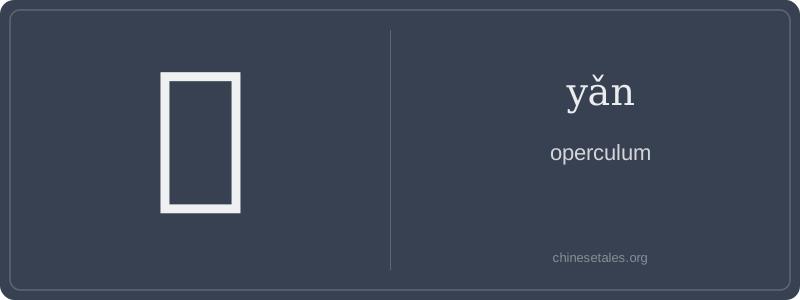
The earliest form of 厣 appears in bronze inscriptions as a stylized depiction of a flat, hinged lid covering an opening — imagine a stone slab tilted slightly over a rectangular cavity, with clear lines suggesting both the cover and its hinge point. Over time, the 'cavity' evolved into the radical 厂 (a cliff or overhanging ledge, hinting at shelter or coverage), while the upper component solidified into 亼 (a variant of 人, here stylized as a downward-facing lid), and the lower stroke became 乚 — a gentle curve representing the sealed edge or the contour of a shell. By the Han dynasty, the structure stabilized into today’s 11-stroke form: 厂 + 亼 + 乚 — three visual layers mimicking a lid resting securely on a recessed surface.
This character’s meaning remained remarkably stable for over two millennia: always a protective, detachable cover — first applied to architectural features (e.g., tomb entrance slabs), then extended to anatomy (gill covers in fish, cranial plates in early medical texts), and finally standardized in modern biology for mollusks and crustaceans. Notably, it appears in the 12th-century pharmacopeia Jīng Shǐ Zhèng Lèi Běn Cǎo, where it describes the hard calcarious plate sealing abalone shells — a usage still current today. Its visual logic — lid-over-cavity — never wavered, making it one of Chinese’s most faithfully pictographic technical terms.
Think of 厣 (yǎn) as Chinese biology’s version of a 'trapdoor' — not the spooky kind, but the elegant, precisely fitted lid that seals a snail’s shell or covers a fish’s gills. In English, we borrow the Latin term *operculum*; in Chinese, this single character carries that entire zoological concept with surgical precision. It’s not a poetic or abstract word: it’s technical, clinical, and almost exclusively used in scientific contexts — like a lab technician pointing to a diagram and saying, 'See this protective cover? That’s the 厣.'
Grammatically, 厣 functions as a noun only — never as a verb or adjective — and almost always appears in compound terms (like 鳃厶 or 螺厶), never alone in speech or writing. You’ll rarely hear it in daily conversation; even many native speakers only encounter it in high-school biology textbooks or aquarium signage. Learners sometimes misread it as yàn (like 焰) or confuse its radical 厂 with the more common 广, but its pronunciation is firmly yǎn — think 'yam' with a rising tone, like you’re lifting a tiny lid.
Culturally, 厣 reveals how Chinese handles scientific terminology: rather than borrowing foreign words wholesale, it often repurposes ancient, visually evocative characters. This one isn’t new — it appears in Song dynasty medical texts describing anatomical coverings — yet it feels refreshingly literal: the top part (the 'lid') sits right over the lower structure, just as the character’s shape suggests. A common mistake? Assuming it relates to 'eye' (眼 yǎn) because of the sound — but there’s zero semantic connection; it’s pure homophone coincidence.