厪
Character Story & Explanation
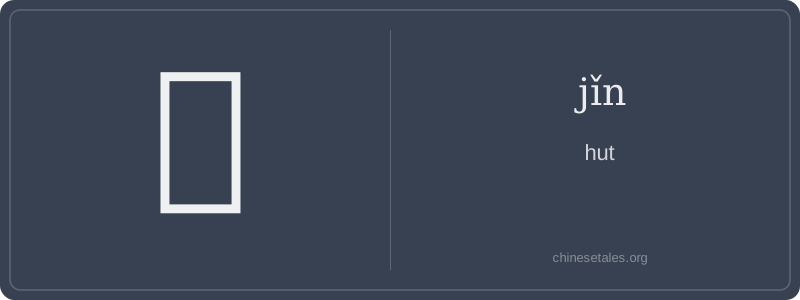
The earliest form of 厪 appears in bronze inscriptions as a pictograph: a slanted roof (厂) over two stacked horizontal lines (冂-like enclosure) and a small dot or stroke beneath — representing a low, roofed space carved into a cliff face or built against a rocky slope. Over time, the lower part evolved: the two horizontals became 井 (jǐng, well — suggesting containment and depth), while the roof radical 厂 remained dominant. By the Han clerical script, the structure stabilized into today’s 厪 — thirteen strokes capturing both shelter (厂) and contained space (井), with the final dot becoming the downward stroke of 井.
This visual logic shaped its meaning: not just any hut, but one anchored to the land — dug in, rock-adjacent, self-sufficient. In the Shuowen Jiezi (121 CE), Xu Shen defined it as ‘a dwelling built against a mountain face’ (依山而居者), distinguishing it from houses on flat ground. Poets like Du Fu used it to contrast imperial grandeur with reclusive humility — e.g., ‘茅厪低小,风掀屋脊’ (My thatched hut is low and small; wind lifts its ridge). Its shape literally holds its meaning: 厂 + 井 = shelter rooted like a well in stone.
Imagine you’re hiking the misty slopes of Mount Emei at dawn, and your guide points to a weathered stone structure clinging to a cliffside — not quite a temple, not quite a shed, but a humble, roofed shelter for monks or travelers. That’s a 厪 (jǐn): a simple, rustic hut, often built into rock faces or nestled in remote terrain. It carries an earthy, almost poetic weight — less generic than ‘house’ (房子) and more specific than ‘shelter’ (遮蔽处). It’s not about comfort; it’s about endurance, solitude, and minimal human presence in nature.
Grammatically, 厪 is a noun that rarely stands alone in modern speech — you’ll almost always see it in compounds like 山厪 (shān jǐn, mountain hut) or 石厪 (shí jǐn, stone hut). It doesn’t take aspect particles (了, 过) or plural markers (们) — it’s inherently singular and uncountable in usage. Learners sometimes mistakenly treat it like 房 (fáng) and say *一厪* — but no: you’d say 一座厪 (yī zuò jǐn), using the classifier 座 for structures built into terrain. It’s also never used for modern buildings — a ‘hut’ on Airbnb isn’t a 厪; it’s a 小屋 (xiǎo wū).
Culturally, 厪 evokes Tang and Song dynasty hermit poetry — think Wang Wei’s quiet retreats — and appears in classical texts describing frontier outposts or Daoist retreats. Modern speakers use it mostly in literary, historical, or regional contexts (e.g., Sichuan or Fujian dialect-influenced writing). A common mistake? Confusing it with the far more common 小屋 or 棚 — but those imply temporariness or crudeness; 厪 implies intentional, enduring simplicity, often with spiritual resonance.