厥
Character Story & Explanation
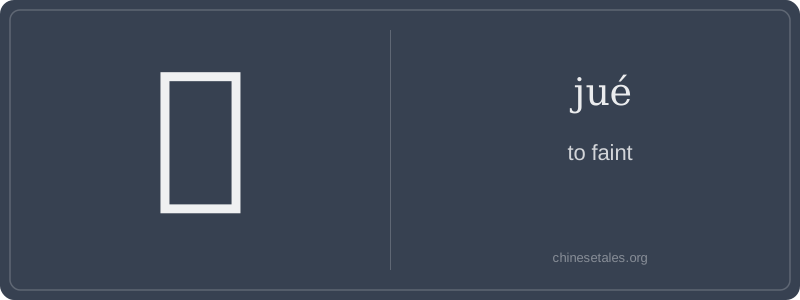
The earliest form of 厥 appears on Warring States bamboo slips as a complex pictograph: a person (人) crouching under a cliff-like roof (厂), with a hand holding a tool (殳) and a foot (疋) — suggesting someone collapsing *beneath* overwhelming pressure or constraint. Over centuries, the ‘person’ and ‘tool’ merged into the top-right component (欮), while the radical 厂 (cliff/overhang) remained dominant — visually anchoring the idea of being overwhelmed *from above*, literally ‘crushed into unconsciousness’.
This image evolved into its current 12-stroke form by the Han dynasty, retaining the ominous weight of the cliff radical. In the Huangdi Neijing (Yellow Emperor’s Classic of Medicine), 厥 describes pathological states where qi rises uncontrollably — like 'liver-qi厥' causing sudden loss of speech or limb paralysis. The character’s shape itself became diagnostic: the 厂 radical implies external suppression, while the internal components suggest internal rebellion — a perfect visual metaphor for the body’s dual crisis of excess and collapse.
At its core, 厥 (jué) isn’t just ‘to faint’ — it’s the classical Chinese word for a sudden, dramatic collapse of vital energy (qì), often triggered by shock, imbalance, or emotional extremity. Think less ‘dizzy spell’ and more ‘the body shutting down mid-sentence because your liver qi just rebelled’. This isn’t casual dizziness; it carries the gravity of ancient medical cosmology, where consciousness and physiology were inseparable.
Grammatically, 厥 is almost never used alone in modern speech — you’ll only encounter it in fixed literary or medical compounds like 厥逆 (jué nì, 'rebellious qi') or 厥证 (jué zhèng, 'syncope syndrome'). It’s a verb that behaves like a noun: you say ‘suffering from 厥证’, not ‘he jué-ed’. Learners sometimes misread it as a standalone action verb (like ‘he fainted’ → *tā jué le), but that construction is archaic and sounds jarringly poetic — like saying ‘he swooned’ in a grocery line.
Culturally, 厥 reveals how deeply Chinese medicine embeds psychology in physiology: fainting isn’t just neurological — it’s evidence of disrupted harmony between yin/yang, heart and kidney, or will and breath. A common mistake? Confusing it with the homophone 缺 (quē, 'to lack') — same tone, totally different universe. Also, never confuse it with the near-identical-looking 氣 (qì) — no relation, despite the shared ‘vital force’ vibe!