厞
Character Story & Explanation
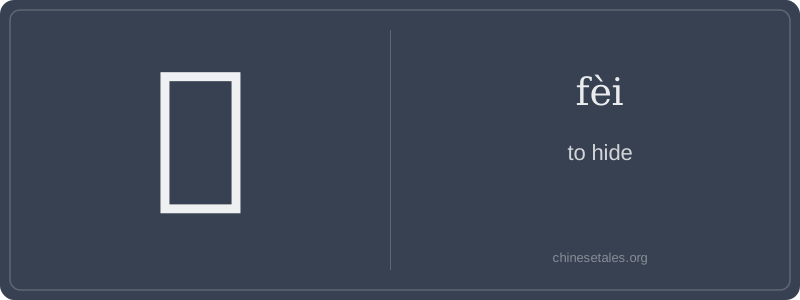
The earliest form of 厞 appears in bronze inscriptions as a complex pictograph: a person (人) tucked beneath a sheltering roof (宀), with an additional stroke suggesting enclosure or boundary — sometimes interpreted as a folded mat or closed door. Over centuries, the human figure simplified into the left-side component (厂 + 一 + 人), while the roof radical 宀 remained intact on top, evolving into today’s elegant, compact structure: 宀 over 厂 over 一 over 人. Crucially, unlike many ‘roof’-radical characters that imply ‘under a roof’ (e.g., 家 jiā, ‘home’), 厞 emphasizes *intentional absence from visibility* — not just being indoors, but choosing invisibility.
This meaning crystallized during the Warring States and Han periods, where texts like the Zhuangzi praised those who ‘fèi jì yú shì’ (vanished from the world’s gaze) to avoid corruption. By the Tang dynasty, poets used 厞 to evoke ethereal disappearance — mist swallowing peaks, scholars dissolving into bamboo groves. Its visual architecture mirrors its semantics: the roof (宀) shelters, the slanted cliff-like (from 厂) suggests concealment behind terrain, and the person (人) is literally *under cover*, not just physically hidden but existentially withdrawn.
At first glance, 厞 (fèi) feels like a quiet, almost secretive character — and that’s exactly its vibe in Chinese. It doesn’t shout ‘hide!’ like 藏 (cáng) or ‘conceal!’ like 掩 (yǎn); instead, it whispers ‘to withdraw into seclusion,’ ‘to lie low,’ or ‘to retreat from view’ — often with a literary, even poetic or classical flavor. Think of a scholar stepping back from court politics, or a hermit vanishing into misty mountains. It’s not about hiding a key or stashing cookies; it’s about intentional, dignified withdrawal.
Grammatically, 厞 is almost exclusively used in written, formal, or classical contexts — you won’t hear it in daily conversation or HSK-level textbooks. It appears as a verb, usually in compound verbs like 厞迹 (fèi jì, 'to vanish without trace') or 厞身 (fèi shēn, 'to withdraw from public life'), and rarely stands alone. Learners sometimes misread it as fěi or fēi — but the fourth tone (fèi) carries a sharp, decisive drop, echoing the finality of retreat. Also, watch out: it’s easily mistaken for characters like 废 or 沸 — but those have entirely different radicals and meanings!
Culturally, 厞 taps into a deep Daoist and Confucian ideal: knowing when to step back is wisdom, not weakness. In classical texts, 厞 often describes sages who ‘fèi shì’ (withdraw from the world) to preserve integrity — a subtle but powerful ethical stance. Modern learners rarely need it for survival, but recognizing it unlocks layers of poetry, historical novels, and philosophical essays. Misusing it as a casual synonym for ‘hide’ sounds oddly archaic — like quoting Shakespeare while ordering takeout.