厝
Character Story & Explanation
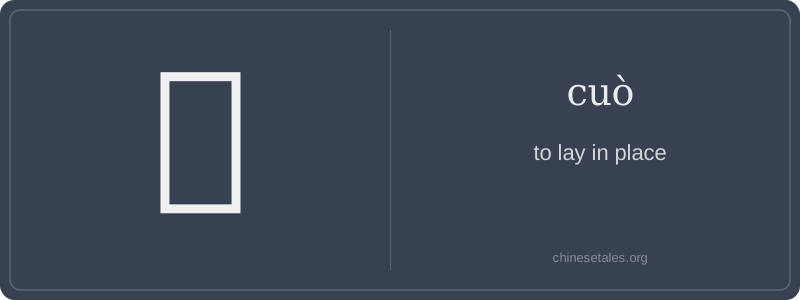
The earliest form of 厝 appears in bronze inscriptions as a compound pictograph: a simplified roof (宀) over a person (人) inside a sheltered cliff-like structure (厂). Over centuries, the person morphed into 克 (kè, ‘to overcome’ — possibly indicating effortful placement), while the roof and cliff merged into today’s 厂 radical atop 克 — resulting in the modern 10-stroke form. Visually, it’s a shelter (厂) cradling purposeful action (克), embodying the idea of placing something *within a protected, intentional space*.
This visual logic shaped its meaning evolution: from early Zhou texts where it meant ‘to house’ or ‘to lodge’ (e.g., in the Zuo Zhuan, ‘厝之于庙’ — ‘lodge [the tablet] in the temple’), it narrowed in later dynasties to emphasize ritual placement — especially of the deceased or sacred objects. By the Ming-Qing period, it became entrenched in funerary language across Fujian and Taiwan, where ‘厝’ also became a common word for ‘house’ itself (as in ‘Hong Kong-style 厝’), reflecting how deeply placement and dwelling are conceptually fused in southern Chinese thought.
Imagine you’re helping an elderly Fujianese aunt move her late husband’s ancestral tablet into the newly renovated ancestral hall. She doesn’t just ‘place’ it — she cuò it: with reverence, precision, and ritual awareness, aligning it perfectly on the altar so his spirit rests properly. That’s 厝 (cuò) — not mere physical placement like 放 (fàng), but deliberate, culturally weighted laying-in-place, often of objects that carry spiritual or familial weight: coffins, tablets, heirlooms, even legal documents in classical contexts.
Grammatically, 厝 is almost always a transitive verb requiring an object and often appears in formal, literary, or regional (especially Minnan/Southern Fujian) usage. You’ll rarely hear it in casual Beijing Mandarin — instead, you’ll find it in funeral notices (‘厝于灵堂’), historical novels (‘厝书于箱底’), or legal texts meaning ‘to file/record’. It never stands alone as a command; you wouldn’t say ‘cuò!’ — you’d say ‘cuò hǎo zhè ge líng wèi’ (place this spirit tablet properly). And crucially: it’s *not* used for everyday items — don’t 厝 your phone on the table! That’s 放 or 摆.
Culturally, 厝 carries deep Minnan resonance — in Hokkien, ‘chhù’ means both ‘to place’ and ‘house’, linking physical placement to dwelling and permanence. Learners often misread it as a variant of 错 (cuò, ‘wrong’) due to identical pinyin and similar sound, but they share zero semantic ground — confusing them could accidentally turn ‘the coffin was respectfully laid’ into ‘the coffin was wrongly placed’! Also, its radical 厂 (cliff/shelter) hints at protection and enclosure — not just location, but *sanctified location*.