厜
Character Story & Explanation
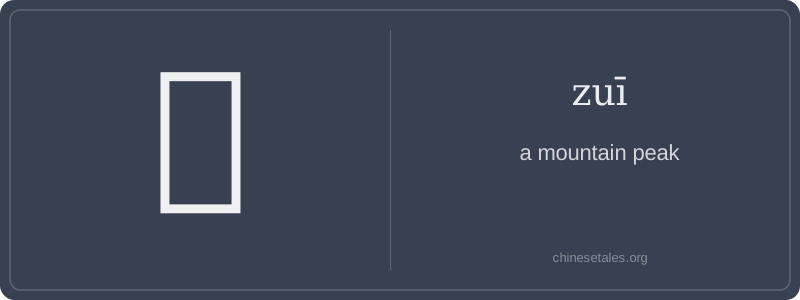
The earliest form of 厜 appears in bronze inscriptions as a stylized, angular depiction of twin rocky spires rising from a base — imagine two sharp, upward-thrusting triangles side by side, rooted in a horizontal line representing the mountain’s shoulder. Over time, the oracle bone script simplified into seal script, where the left radical 山 (shān, 'mountain') anchored the character, while the right component 隹 (zhuī, originally 'short-tailed bird') was borrowed purely for sound (zuī), though its avian origin is now invisible — a classic case of phonetic loan. The modern form retains this structure: 山 on the left, 隹 on the right, but the 'bird' has morphed into a compact, top-heavy cluster of strokes that visually echoes a serrated ridge.
This visual pun — using a 'bird' component to suggest something soaring and pointed — subtly reinforces the meaning: just as birds ascend sharply, so too does 厜 denote the highest, most piercing point of terrain. By the Han dynasty, it appeared in texts like the Shuōwén Jiězì, defined as 'the sharp apex of a mountain'. Later, poets like Li Bai and Wang Wei employed 厜 in compound terms like 厜㕒 (zuī yí) to evoke not just height, but intricate, layered rock formations — a semantic shift from 'single peak' to 'complex, interlocking crags'.
Think of 厜 (zuī) as Chinese poetry’s version of a dramatic mountain silhouette in a Renaissance painting — not just any peak, but the sharp, jagged, almost defiant tip where sky and stone collide. In classical Chinese, it evokes verticality, isolation, and sublime austerity: it’s the kind of peak you’d find in Tang dynasty landscape scrolls or Du Fu’s verses on remote frontier passes. Unlike common words like 山 (shān, 'mountain') or 峰 (fēng, 'peak'), 厜 is rare, literary, and never used alone in speech — it only appears embedded in compound nouns or poetic descriptions.
Grammatically, 厜 functions exclusively as a noun modifier — always part of a two- or three-character compound, never a standalone subject or verb complement. You’ll never say 'I climbed 厜' — instead, you might read '厜㕒' (zuī yí) in a classical text describing craggy, interlocking cliffs. Learners mistakenly try to use it like 峰 or 顶 (dǐng, 'summit'), but 厜 carries no colloquial or modern usage; even native speakers may need to pause and recall its meaning from context or dictionary.
Culturally, 厜 belongs to the 'ink-washed lexicon' — characters preserved not for daily utility but for aesthetic precision in calligraphy, classical poetry, and scholarly annotation. Its rarity means mispronunciation (e.g., confusing zuī with zuǐ or zhuī) is common, and many learners skip it entirely — missing out on how Chinese masters wielded single characters like brushstrokes to conjure atmosphere, not just geography.