卐
Character Story & Explanation
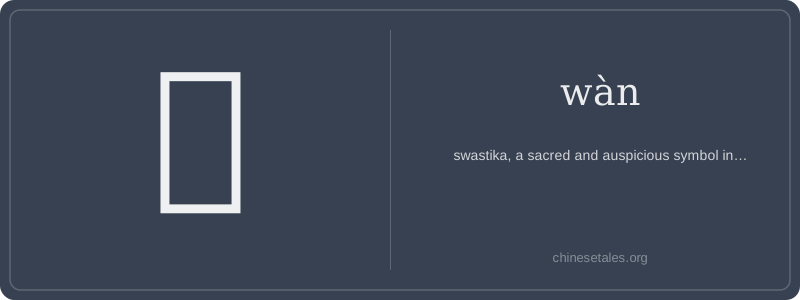
The earliest known appearance of 卐 in Chinese contexts isn’t in oracle bones or bronze inscriptions — it doesn’t originate in Chinese writing at all. Instead, it entered China via Sanskrit Buddhist texts around the 1st–2nd century CE, where it was rendered as a stylized, symmetrical, four-armed cross with arms bent at right angles — often clockwise (右旋, yòu xuán). Early scribes didn’t ‘draw’ it stroke-by-stroke like 水 or 木; they replicated its sacred geometry precisely, treating it as a single, indivisible unit — hence the ‘0 strokes’ designation. No brushwork evolution occurred; its form remained stable because its sanctity demanded fidelity, not linguistic adaptation.
Over centuries, 卐 became embedded in Chinese Buddhist material culture — carved on temple pillars, embroidered on monastic robes, stamped on sutra covers — always retaining its Indian origin meaning: auspiciousness, eternity, and the Buddha’s heart-mind. Classical sources like the Avataṃsaka Sūtra (Huáyán Jīng) describe it as one of the 32 major marks of a Buddha’s body. Crucially, Chinese scholars never assigned it phonetic components or semantic radicals — they accepted it as a transcendent symbol, not a morpheme. Its visual perfection — rotational symmetry, balance, and infinite continuity — mirrors its meaning: no beginning, no end, pure presence.
Let’s get one thing crystal clear: 卐 is not a Chinese character in the conventional sense — it’s a borrowed sacred symbol, transcribed into Chinese writing like a foreign loanword. Pronounced wàn (with the fourth tone), it carries zero grammatical function in Mandarin: no verbs, no adjectives, no particles. It appears almost exclusively as a standalone glyph — a visual icon — in Buddhist temples, ancient sutra manuscripts, or academic texts discussing Indian religions. You’ll never see it in daily conversation, nor in HSK vocabulary. Its ‘meaning’ isn’t lexical but iconic: it’s the swastika — an ancient, clockwise-turning solar and auspicious sign revered for millennia across South and East Asia.
Grammatically, 卐 behaves like a proper noun or logographic loan symbol: it’s always written alone, never compounds with other characters to form new words (unlike true Chinese morphemes). You won’t say ‘wàn de’ (‘of the swastika’) or ‘wàn le’ (‘swastika-ed’). When used in modern Chinese, it’s typically in scholarly contexts — e.g., ‘卐字纹’ (wàn zì wén, ‘swastika motif’) — where 卐 acts as a frozen classifier-like prefix, not a productive root. Learners sometimes mistakenly assume it’s a verb or try to use it as a measure word — a dead end. It has no strokes, no radical, no internal structure: it’s a geometric ideograph, not a constructed character.
Culturally, this symbol is profoundly sensitive. In China, it’s recognized solely in its pre-20th-century religious context — never associated with Nazi ideology, which uses a rotated, tilted, and black-on-white version (卐 vs. the Nazi Hakenkreuz). Still, due to global awareness, many Chinese publishers now avoid printing 卐 outright, opting instead for descriptive phrases like ‘右旋万字符’ (yòu xuán wàn zì fú, ‘right-turning swastika symbol’). The biggest mistake? Assuming it’s ‘just another character’ — it’s not. It’s a sacred glyph wearing Chinese script’s clothing.