卍
Character Story & Explanation
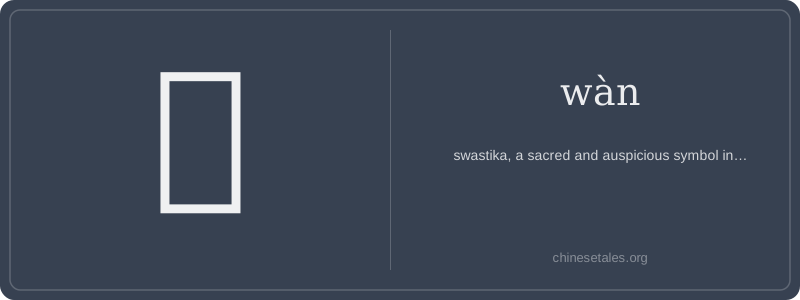
The earliest known appearance of 卍 in China isn’t as a written character but as a ritual motif — carved onto Neolithic pottery shards (c. 3000 BCE) and later etched into Han dynasty bronze mirrors and Buddhist cave murals at Dunhuang. Unlike true characters, it has no oracle bone or seal script evolution because it wasn’t originally part of the logographic system. Its form — four arms bent at right angles, rotating counterclockwise — mimics cosmic whirls, sun rays, and the turning wheel of dharma. Over centuries, artisans standardized it into a clean, symmetrical glyph, always with arms pointing inward and ending in gentle hooks — never sharp or angular like Western variants.
By the Tang dynasty, scholars like Xuanzang explicitly transcribed it as wàn (meaning 'ten thousand' — symbolizing boundlessness) in sutra translations, linking its endless rotation to the infinite compassion of the Buddha. Classical texts rarely discuss it as a 'character'; instead, it appears in technical art manuals describing temple decoration or in Buddhist apocrypha like the Sutra of the Ten Wheels, where it marks the chest of enlightened beings. Visually, its perfect symmetry and lack of strokes make it uniquely anti-linguistic — a silent, sacred icon that transcends writing itself.
First, let’s clear up a big misconception: 卍 isn’t a ‘Chinese character’ in the traditional sense — it has zero strokes, no radical, and isn’t part of the standard writing system. It’s a borrowed sacred symbol (called wàn zì in Chinese), adopted from ancient Indian religions to represent auspiciousness, eternity, and the Buddha’s infinite wisdom. In Chinese Buddhist contexts, it’s read as wàn and feels warm, protective, and deeply spiritual — never neutral or decorative.
Grammatically, 卍 doesn’t function like a word at all: it’s not a noun, verb, or modifier you conjugate or combine freely. You’ll only encounter it embedded in proper nouns (e.g., 卍字纹 wàn zì wén — 'swastika motif') or religious terms (e.g., 卍字锦 wàn zì jǐn — 'swastika-patterned brocade'). Crucially, it never appears alone in sentences as a lexical item — unlike characters such as 佛 (fó, 'Buddha'), it carries no grammatical weight. Learners sometimes mistakenly try to use it as a standalone noun ('a swastika') — but in Chinese, you’d say 万字符 (wàn zì fú) or 卍字符号 (wàn zì fú hào), never just 卍.
Culturally, this symbol is profoundly positive in East Asia — appearing on temple gates, sutra covers, and Tang-dynasty bronze mirrors — yet Western learners often flinch due to its Nazi appropriation. That dissonance is real, but in Chinese usage, 卍 carries zero political connotation; misreading it as sinister reflects cultural translation failure, not linguistic ambiguity. Also: never confuse it with the right-facing Nazi variant (卐); traditional Chinese Buddhist art uses *only* the left-facing 卍 — a subtle but sacred distinction.