卌
Character Story & Explanation
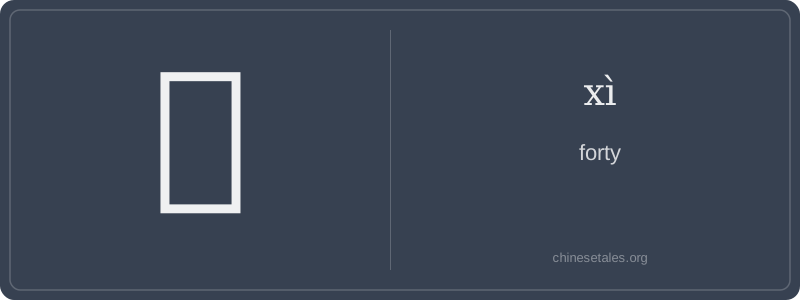
Carved into oracle bones over 3,000 years ago, 卌 began as four parallel horizontal lines — a direct tally mark for 'four tens'. In early bronze script, these lines were stacked neatly above a base line representing 'ten' (十), evolving into a cross-like structure where four short strokes branch symmetrically from the center of 十. By the small seal script era (Qin dynasty), the form stabilized: the central 十 became the anchor, and exactly four short strokes — two on top, two below — radiated outward, each deliberately equal in length and angle. This wasn’t abstraction; it was accounting clarity — a visual '4 × 10' before multiplication symbols existed.
Its meaning never wavered — always 'forty' — but its usage narrowed dramatically after the Han dynasty. While the *Shuōwén Jiězì* (121 CE) catalogued it as a legitimate numeral, later dynasties preferred the phonic compound 四十 for clarity in administration. Still, 卌 persisted in elite circles: Tang poets used it to compress meter ('卌万甲兵' — 'forty myriads of armored troops'), and Ming scholars engraved it on scholar’s rocks as a mark of refined brevity. Its shape — a balanced, almost sacred cross — subtly echoed cosmological ideas of four directions and ten heavens, making it more than arithmetic: a tiny mandala of order.
卌 is a fossilized numeral — not a character you’ll hear in daily speech or see on subway signs, but one that whispers from ancient ledgers, classical poetry, and scholarly texts. Its meaning is straightforward: 'forty'. Yet its feel is anything but casual: it carries the austerity of ink-brushed account books, the precision of imperial census records, and the quiet weight of literary economy. Unlike the standard spoken form 四十 (sì shí), 卌 is a single-character shorthand — a compact glyph born from efficiency, not phonetics.
Grammatically, 卌 functions only as a numeral, never as a standalone word or part of compound verbs. You’ll find it almost exclusively in fixed literary expressions like 卌年 (xì nián, 'forty years') or in historical contexts: '卌载春秋' (xì zǎi chūn qiū) — 'forty years of spring and autumn', evoking dynastic time. Crucially, it cannot replace 四十 in modern speech or writing; saying '我卌岁了' would sound archaic or jarringly poetic — like greeting someone with 'Verily, I am forty!' instead of 'I’m forty.'
Culturally, 卌 is a classic 'inkwell character': revered by calligraphers for its elegant symmetry (four strokes radiating from 十), yet nearly extinct in spoken Mandarin. Learners often mistakenly assume it’s a simplified variant or a dialect form — it’s neither. It’s a survivor: used in some regional inscriptions (e.g., Fujian temple steles), legal documents before the 20th century, and occasionally revived in artistic names or poetic titles for gravitas. The biggest trap? Confusing it with 井 (jǐng, 'well') or 卅 (sà, 'thirty') — both visually similar but historically distinct.