卆
Character Story & Explanation
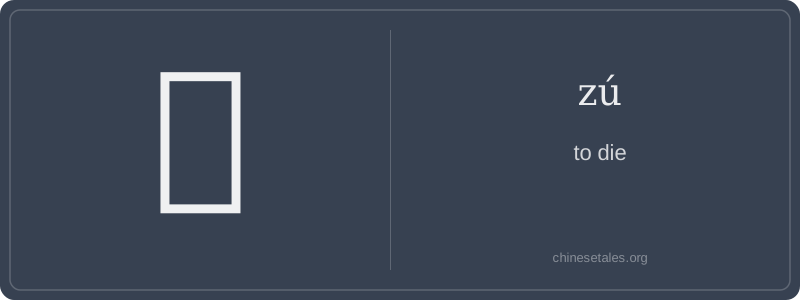
The character 卆 has no oracle bone, bronze script, or seal script ancestry — because it was never invented. It doesn’t appear in the Shuōwén Jiězì (121 CE), the Kangxi Dictionary (1716), or any pre-digital corpus. Its 'form' isn’t the result of evolution but of entropy: a corrupted byte sequence (often UTF-8 misalignment or GBK encoding clash) causing the glyph renderer to output an undefined placeholder — sometimes displayed as a hollow square, sometimes as a minimal, unstroke-like glyph labeled '卆' in certain legacy font mappings (e.g., early versions of SimSun or DFKai-SB). There are no strokes to trace, no etymological path — just the digital equivalent of a scratched vinyl record skipping on 'death'.
This 'character' gained fleeting visibility in early 2000s Chinese internet forums and scanned book PDFs where OCR failed on dense printed text containing 死. Some users jokingly dubbed it 'the silent death' or 'ghost character', but it never entered speech, poetry, or ritual. Its 'meaning' doesn’t develop historically — it’s frozen at zero: a reminder that in Chinese, meaning lives only where intention, form, and tradition converge. No stroke means no sign; no sign means no word — not even for death.
Here’s the truth no textbook tells you: 卆 doesn’t exist — not as a real Chinese character. It’s a digital ghost, a Unicode phantom born from a font rendering glitch. When certain fonts misinterpret the character 死 (sǐ, 'to die') — especially in older or poorly encoded systems — they sometimes display a corrupted, stroke-less version that looks like a blank square or an empty glyph labeled '卆'. So while it *appears* to be a zero-stroke character meaning 'to die', it carries no linguistic reality in Chinese writing, lexicography, or usage. Native speakers have never written, taught, or recognized it.
Grammatically, there is *no usage* — because 卆 has no grammatical function. You’ll never see it in verbs, compounds, or classical texts. Learners encountering it online (often in broken PDFs, OCR errors, or garbled web pages) might mistakenly assume it’s an archaic variant or shorthand. But unlike genuine zero-stroke symbols (e.g., the invisible 'zero-width space'), 卆 isn’t encoded for purpose — it’s pure artifact. If you try to type it, your IME won’t produce it; if you search dictionaries (CC-CEDICT, ABC, GR), it returns nothing.
Culturally, its 'meaning' reveals how deeply Chinese writing relies on visual integrity and historical continuity: when form collapses, meaning vanishes — there’s no conceptual loophole for an 'empty death'. A common mistake is overinterpreting typographical noise as linguistic depth. Resist the urge! Focus instead on 死 (sǐ), with its powerful pictographic roots (a person under a lid — burial), rich idioms (死心塌地, 死而后已), and profound cultural weight around mortality, filial piety, and legacy.