卅
Character Story & Explanation
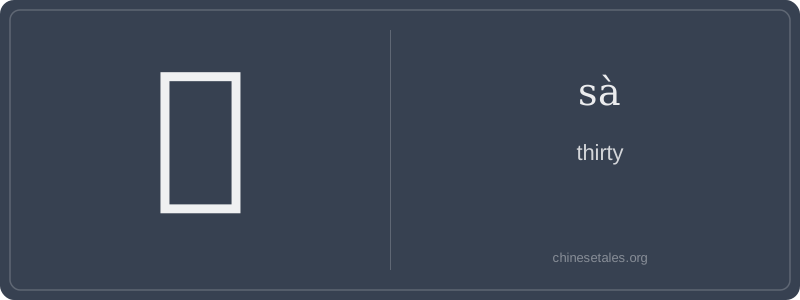
The earliest form of 卅 appears in Western Zhou bronze inscriptions as three distinct, vertically aligned 十 symbols — each a cross representing 'ten' — stacked neatly like tally marks. Over centuries, scribes began linking them: the top stroke of the second 十 merged with the bottom stroke of the first, and the third slid upward, compressing the trio into a tight, symmetrical four-stroke glyph. By the Qin dynasty’s small seal script, the fusion was complete: three horizontal lines (each originally the top bar of a 十) and one long vertical stroke running through all — the modern 卅. Its shape isn’t arbitrary: it’s arithmetic made architectural — three tens literally built upon one another.
This visual logic anchored its meaning: 卅 wasn’t just '30' — it was 'three tens, inseparable'. In the Book of Documents, it appears in age references ('the ruler reigned for 卅 years'), reinforcing its role in marking solemn, cyclical time. Unlike the flexible, spoken sān shí, 卅 carried gravitas — reserved for rites, records, and rites of passage. Even today, its four strokes mirror the structure of traditional Chinese timekeeping: three decades forming one generation, held together by the unbroken line of lineage.
Imagine a scribe in ancient China, carving numbers into oracle bones — not with digits, but with elegant, symbolic strokes. 卅 (sà) is one of those fossilized numerals: a compact, stylized shorthand for 'thirty', born from three stacked 十 (shí, 'ten') characters fused into a single glyph. It’s not a pictograph of objects, but of arithmetic logic — three tens, visually compressed like a mathematical equation made visible. Today, it carries a distinctly classical, almost poetic weight: you’ll rarely hear it spoken aloud (people say sān shí instead), but you’ll see it in formal inscriptions, historical texts, and calligraphy — where brevity and elegance trump colloquial clarity.
Grammatically, 卅 functions strictly as a numeral modifier, always preceding nouns or measure words — never standing alone. Think of it like Roman numerals in English: you’d write 'XXX years' on a monument, not say 'triple-x years' in conversation. So 卅年 (sà nián) means 'thirty years', but you’d never say *'sà' by itself to mean 'thirty'. Learners sometimes mistakenly use it in speech or try to pluralize it — but it has no verb forms, no aspect particles, and zero flexibility. It’s a static, ceremonial token — not a working word.
Culturally, 卅 appears in idioms like 卅年河东,卅年河西 (sà nián hé dōng, sà nián hé xī) — 'thirty years east of the river, thirty years west', meaning fortunes reverse over time. Its rarity makes it a subtle marker of literacy and cultural fluency; spotting it in a museum plaque or antique scroll feels like decoding a secret handshake. The biggest mistake? Confusing it with 十 (shí) or 卅 (sà) with 午 (wǔ). Remember: this character isn’t used in daily life — it’s a quiet echo of China’s written past, preserved in ink, not speech.