卄
Character Story & Explanation
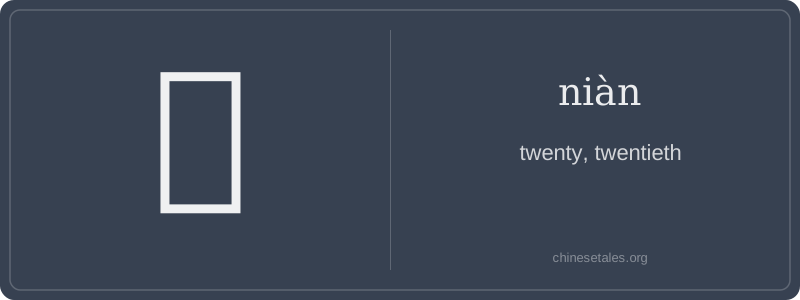
Carved onto oracle bones over 3,000 years ago, the earliest ancestor of 卄 wasn’t a number at all — it was a stylized double-barred staff or tally stick, representing repeated counting. By the Shang and Zhou bronze inscriptions, it evolved into two parallel horizontal strokes crossed by a single vertical stroke — a clear doubling of 十’s structure. Over centuries, scribes streamlined it: the top and bottom horizontals merged into one continuous stroke bridging the vertical, yielding the clean, symmetrical three-stroke form we see today — two 'tens' fused into one glyph, like stacked bamboo rods bound together.
This visual stacking mirrors ancient Chinese arithmetic: multiplication wasn’t abstract but physical — bundling units into groups. So 卄 didn’t just mean '2 × 10'; it evoked the act of tying two complete sets of ten together. In the *Zuo Zhuan*, '卄有三年' (twenty-three years) appears in annals of state rituals — always in formal chronology, never casual speech. Its vertical symmetry also subtly echoes Confucian ideals of balance and order: two equal tens, perfectly aligned, reflecting harmony in measurement and governance.
At first glance, 卄 looks like a tiny, elegant twin of 十 — and that’s exactly the point. It’s not a standalone concept but a visual doubling: two tens stacked vertically to mean 'twenty' (niàn). Unlike Western numerals where '20' is a composite digit, 卄 is a compact ideographic fusion — revealing how Chinese conceptualizes numbers as layered ideas rather than linear digits. You’ll rarely see it in modern daily life; it’s mostly found in classical texts, historical documents, or formal contexts like imperial reign years (e.g., 卄年 for 'the twentieth year of a reign').
Grammatically, 卄 functions identically to other numerals: it modifies nouns directly ('卄人' — twenty people) or appears in ordinal constructions ('卄日' — the twentieth day). But here’s the catch: learners often misread it as 十 (shí) or confuse it with 廿 (niàn), its cursive sibling — both meaning 'twenty', yet visually distinct. Crucially, 卄 is *not* used in spoken Mandarin; you say èr shí, never niàn, in conversation. Its presence is purely written — a silent, elegant fossil of literary Chinese.
Culturally, 卄 embodies the elegance of economy in Chinese writing: three strokes do the work of four (èr shí). Yet its rarity makes it a subtle marker of literacy — spotting it signals familiarity with pre-modern registers. A common mistake? Assuming it’s interchangeable with 廿. While both mean 'twenty', 廿 is cursive and colloquial (still used in Cantonese-influenced contexts), whereas 卄 is archaic, vertical, and strictly formal. Neither appears in HSK — they’re linguistic heirlooms, not classroom tools.