卂
Character Story & Explanation
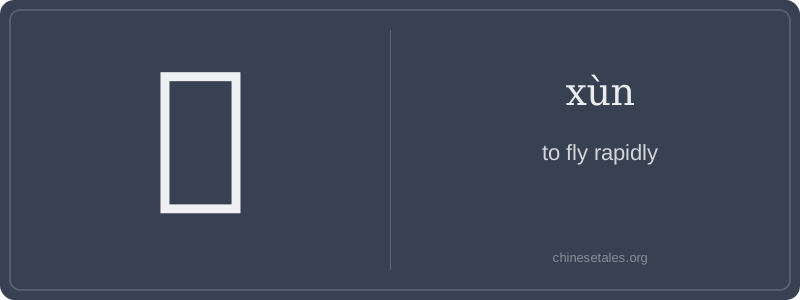
The earliest form of 卂 appears in late Shang oracle bone inscriptions as a dynamic, asymmetrical glyph: a single bold stroke slashing downward-right, topped by two short, diverging strokes suggesting wings or wind-torn feathers — not a bird body, but pure *motion captured mid-explosion*. By the Zhou bronze script era, the top strokes simplified into a horizontal and diagonal line, while the main stroke curved slightly, evoking forward propulsion. In seal script, the shape crystallized into today’s three-stroke form: a dot (丶) at the top left, a rising diagonal (丿), and a long, decisive falling stroke (丨) — together forming a visual exclamation mark of velocity.
This wasn’t just ‘flying’ — it was *unstoppable, directional release*, like a bowstring snapping. Early texts used 卂 to describe the instantaneous departure of spirits (《楚辞》: '魂卂逝兮不复还' — 'The soul flies off in a flash, never to return') or the sudden collapse of dynasties. Its minimalism reflects ancient Chinese aesthetics: maximum meaning with minimum form. Even Confucius reportedly praised the character’s 'unadorned truth' — three strokes that say more than a paragraph about impermanence and force.
Think of 卂 (xùn) as Chinese calligraphy’s version of a sonic boom — not the noise, but the *instantaneous burst* of motion. It doesn’t mean ‘to fly’ in the gentle, gliding sense like 飞 (fēi); it’s the sharp, almost violent *whoosh* of something tearing through air — a falcon stooping, an arrow loosing, a startled bird exploding upward. In classical Chinese, it functions almost exclusively as a verb modifier or poetic intensifier, rarely standing alone in modern speech. You’ll find it embedded in compound verbs or literary descriptions: 卂然 (xùn rán), meaning 'in a flash', or 卂逝 (xùn shì), 'vanishing instantly' — always carrying urgency and irreversibility.
Grammatically, 卂 is a fossilized classical verb — you won’t use it like 吃 or 走. It appears almost exclusively in set phrases or literary allusions. Learners often mistakenly try to conjugate it ('I xùn-ed yesterday') or pair it with objects ('xùn the mountain'), but it doesn’t take direct objects and has no aspect particles (了, 过). Its power lies in its austerity: three strokes, one syllable, zero tolerance for grammatical padding.
Culturally, 卂 carries the aesthetic weight of *shùn* (instantaneity) in Daoist and Chan Buddhist texts — the sudden awakening, the unmediated leap from stillness to action. Modern learners rarely encounter it outside poetry, classical exams, or calligraphy scrolls. The biggest mistake? Confusing its radical (十) with its function — it’s not about ‘ten’ or ‘crossing’, but about *directional thrust*. And yes — it’s so rare that even many native speakers need a dictionary to confirm they’ve seen it before.