匿
Character Story & Explanation
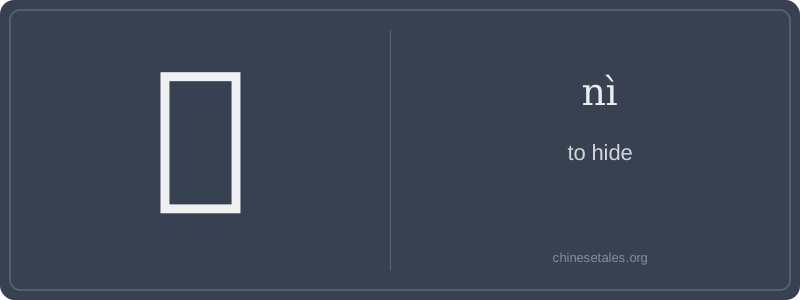
The earliest form of 匿 appears in bronze inscriptions as a compound pictograph: a person (人) crouching inside a low, sheltering enclosure (匸), sometimes with an added ‘mouth’ (口) or ‘heart’ (心) to stress intentional silence or inner concealment. Over centuries, the person simplified into the top component 丨 (a vertical stroke representing posture) and 丶 (a dot for the head), while the enclosure 匸 became the left radical — its curved stroke wrapping protectively around the hidden figure. The right side evolved into 若, originally a pictograph of a woman’s hair and hands, later repurposed phonetically (ruò → nì via sound shift in Old Chinese dialects). By the seal script era, the character had stabilized into its modern ten-stroke structure: 匸 + 若, visually sealing secrecy within form.
This evolution mirrors its semantic journey: from physical hiding (a person ducking into a cave, as in early Zhou texts) to abstract concealment — suppressing facts, masking intent, or evading accountability. Confucius himself warned against ‘匿怨而友其人’ (concealing resentment while pretending friendship — Analects 5.25), highlighting 匿’s moral gravity. Even today, when Chinese media reports ‘某官员匿产’ (an official concealed assets), the character doesn’t just describe action — it implies ethical breach. Its shape remains a silent covenant: what’s under 匸 stays unseen — by choice, not accident.
Imagine 匿 not as a dry dictionary entry, but as a stealthy whisper in classical Chinese — the kind of hiding that’s deliberate, secretive, even slightly ominous. Its core meaning isn’t just ‘to hide’ like tucking a toy under a pillow; it’s to conceal *intentionally*, often with a sense of evasion, secrecy, or shame. Think hiding evidence, concealing identity, or suppressing truth — it carries moral weight. In grammar, 匿 is almost always used in formal or literary contexts: as a verb (e.g., 匿名 — ‘to conceal one’s name’), in compound verbs (匿藏, 匿迹), or in fixed phrases like ‘匿而不见’ (‘refuse to appear, hiding oneself’). You’ll rarely hear it in casual speech — no one says ‘我匿起来了!’ on WeChat.
Learners often mistakenly treat 匿 like a general-purpose ‘hide’ and try to use it where 隐藏 or 躲 would be natural — but that sounds stiff or archaic, like saying ‘thou dost conceal thy face’ instead of ‘you’re hiding’. It’s also frequently mispronounced as ní (with rising tone) instead of nì (falling tone), which changes nothing phonetically in isolation but breaks the rhythm of compounds like 匿名 (nì míng).
Culturally, 匿 shows up where discretion meets consequence: anonymous online posts (匿名评论), fugitives vanishing from records (销声匿迹), or historical figures erasing their traces (匿其名以避祸). Its radical 匸 (xì) — the ‘hiding enclosure’ — appears in only a handful of characters (like 区, 匹), all subtly tied to containment or division. That narrow, sheltering shape? It’s the visual echo of a secret tucked behind a curtain — not lost, but deliberately out of sight.