匴
Character Story & Explanation
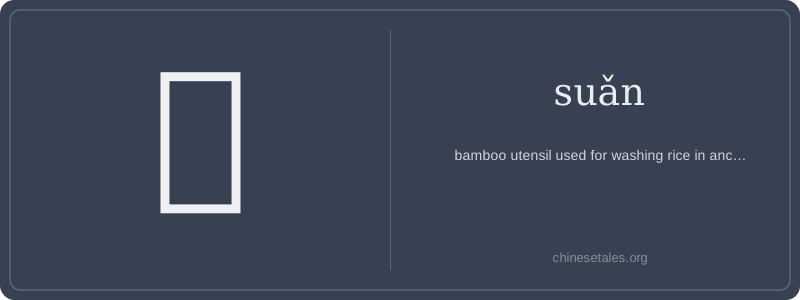
The earliest form of 匴 appears on Warring States bamboo slips—not as a pictograph, but as a highly stylized compound: the top half (bamboo radical) originally depicted two parallel stalks with leafy branches, while the bottom half 曾 was borrowed phonetically (c. 4th c. BCE) but also subtly evoked layered bamboo slats interwoven like latticework. Over centuries, 曾 simplified from ⺼+曰+八 to its current shape, and the bamboo radical shrank vertically, compressing the visual impression of fine, horizontal weaves—so the whole character came to look like a cross-section of a shallow, ribbed basket viewed from above.
This wasn’t abstract symbolism—it was engineering notation. In the Rites of Zhou, 匴 appears alongside other ritual vessels like 簋 (guǐ, food vessel) and 簠 (fǔ, grain box), specifying precise dimensions: 'a 匴 must be three cun deep, seven cun wide, with gaps no wider than one grain of millet.' Its meaning never broadened—unlike 筐 (basket) or 篮 (basket), 匴 stayed stubbornly specific to rice-washing. Even in Tang poetry, when poets described kitchen scenes, 匴 was invoked only to evoke antiquity or austerity—never as a metaphor. Its visual rigidity mirrors its semantic precision: a single function, a single form, a single moment in time—rinsing rice before fire touched it.
Imagine holding a slender, woven bamboo basket in your hands—slats spaced just right to let water and husks slip through while cradling precious rice grains. That’s the soul of 匴 (suǎn): not just a tool, but a quiet testament to ancient Chinese domestic ritual. Its meaning is hyper-specific: a shallow, open-weave bamboo utensil used exclusively for rinsing uncooked rice before cooking—a pre-Qin kitchen essential that vanished from daily life but survived in texts like the Rites of Zhou. You’ll almost never see it in modern speech or writing; it’s a lexical fossil, appearing only in classical references, museum labels, or scholarly reconstructions of early material culture.
Grammatically, 匴 functions solely as a noun—never a verb, adjective, or modifier—and carries no derivational affixes. It doesn’t combine freely: you won’t find 匴子 or 匴儿 (unlike 碗→碗子). Learners sometimes misread it as a variant of 算 (suàn, 'to calculate') due to phonetic similarity, but 匴 has zero semantic overlap with arithmetic—it’s purely tactile, botanical, and functional. Its pronunciation suǎn even mimics the soft *shush* sound of rice swirling in bamboo mesh.
Culturally, 匴 reveals how deeply Chinese civilization encoded ecology into language: bamboo’s flexibility, breathability, and abundance made it ideal for grain-washing—no metal corrosion, no wood splintering, no clay cracking. Modern learners often skip characters like this, assuming they’re ‘useless’—but encountering 匴 opens a doorway to understanding why ancient kitchens were bamboo forests, and why every grain was ritually cleansed before becoming sustenance for ancestors and family alike.