匮
Character Story & Explanation
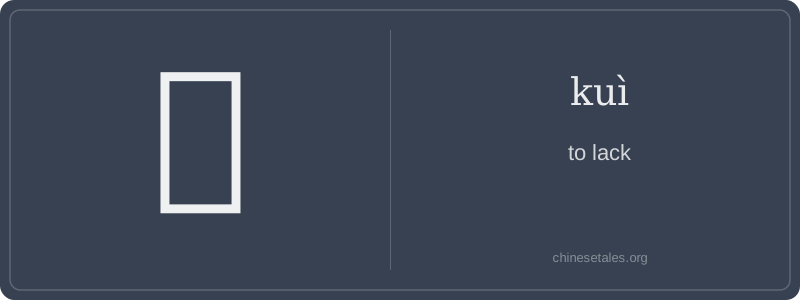
The earliest form of 匮 appears in bronze inscriptions (c. 1000 BCE) as a pictograph of a covered storage chest (匚) with a lid and contents inside — often drawn as three horizontal strokes representing stored grain or ritual objects. Over centuries, the top evolved into 厶 (sī), a simplified glyph for 'secret' or 'hidden', suggesting things concealed *within* the chest. By the Small Seal Script (Qin dynasty), the structure stabilized: 匚 (enclosure) + 厶 (hidden/contained element) + 工 (gong, originally a tool or support, later stylized as a structural base). The 11 strokes reflect this layered history — not random lines, but a visual metaphor for containment that has gone silent, empty, and exposed.
This emptiness wasn’t accidental: in the *Zuo Zhuan*, 匮 describes depleted state coffers during famine — not mere shortage, but institutional failure. Later, in Tang poetry, it acquired ethical resonance: Du Fu wrote of '仁心不匮' ('benevolence never runs dry'), using 匮 as the negative anchor — implying virtue *must not* become void. Its shape remains a paradox: the enclosure 匚 promises containment, yet the interior (the 厶 + 工) reads as 'what was hidden is now gone'. That visual tension — full container / empty meaning — is why 匮 still feels solemn, even in bureaucratic reports today.
匮 (kuì) is a quietly powerful character meaning 'to lack' or 'to run out of' — not just in quantity, but in essence. Think of it as the linguistic equivalent of an empty cupboard that used to hold something vital: medicine, trust, time, or goodwill. Unlike common verbs like 缺 (quē), which is neutral and frequent in daily speech (e.g., 缺钱), 匮 carries literary weight and often appears in formal, classical, or solemn contexts — especially when scarcity has moral or systemic gravity (e.g., 资源匮乏). It’s rarely used alone; you’ll almost always see it in compounds like 匮乏 or 匮缺.
Grammatically, 匮 itself is archaic as a standalone verb in modern Mandarin — you won’t hear someone say '我匮钱' in conversation. Instead, it functions almost exclusively within two-syllable adjectives: 匮乏 (kuìfá, 'severely lacking') and 匮缺 (kuìquē, 'critically insufficient'). These are predicate adjectives, commonly modifying nouns ('人才匮乏', '资金匮缺') or serving as predicates ('目前师资严重匮乏'). Learners sometimes mistakenly use 匮 as a verb like 缺, leading to unnatural phrasing — a red flag that signals textbook overreach rather than real fluency.
Culturally, 匮 evokes Confucian and Daoist sensibilities about sufficiency and balance: the *Dao De Jing* warns against excess precisely because it leads to 匮 — depletion of virtue or harmony. Modern usage retains this gravity: saying '生态资源日益匮竭' isn’t just stating a fact — it’s sounding an alarm. A classic learner trap? Mixing up its radical 匚 (a box-like enclosure) with the more common 冂 (jiōng, 'arch') or 匸 (xì, 'conceal') — but 匚 here isn’t decorative; it’s a container turned hollow, echoing the core idea: what *should* be inside… isn’t.