匠
Character Story & Explanation
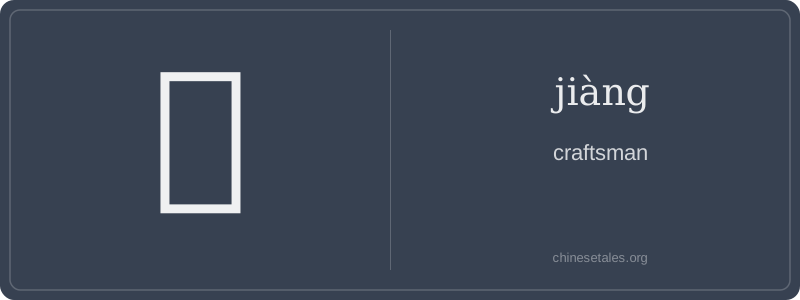
The earliest form of 匠 appears in bronze inscriptions as a stylized pictograph: a square or rectangular frame (the ancestor of 匚) containing two parallel horizontal strokes — representing tools laid neatly inside a workshop cabinet or a craftsman’s carefully arranged chisels and planes. Over centuries, the inner strokes simplified into the modern ‘pin’ shape (匚 + the two horizontal lines plus the final vertical stroke), while the enclosing radical stabilized as 匚 — the ‘box’ or ‘container’ radical, symbolizing the bounded, disciplined space where mastery unfolds.
By the Warring States period, 匠 had crystallized as a term for skilled artisans — distinct from mere laborers (徒) or overseers (工师). Mencius praised the ‘woodcutter who understands the mountain’ and the ‘craftsman who knows the grain’, linking 匠 to intuitive, embodied knowledge. Its visual structure — containment + order — mirrors the classical ideal: true skill isn’t wild inspiration, but deep discipline held within clear boundaries. Even today, seeing 匠 evokes that image: not chaos, but the serene control of hands that have shaped thousands of objects.
At its heart, 匠 (jiàng) isn’t just ‘craftsman’ — it’s the quiet reverence for mastery: the carpenter who measures twice before cutting, the inkstone carver whose chisel never slips, the master who *knows* wood grain like breath. Unlike generic terms like 工人 (gōngrén, 'worker'), 匠 carries weight — it implies decades of apprenticeship, an almost spiritual devotion to precision and form. You won’t find it in casual speech; it’s reserved for titles (木匠, 铁匠), honorifics (能工巧匠), or poetic praise.
Grammatically, 匠 is almost always a noun — rarely used alone, but commonly as the second character in compound nouns (e.g., 画匠, 泥匠). It doesn’t verbify easily (no *‘to匠’*), and learners often mistakenly try to use it adjectivally (e.g., *‘jiàng de skill’*) — but Chinese uses 工匠精神 (gōngjiàng jīngshén, 'craftsman spirit') or skilled adjectives like 精湛的 (jīngzhàn de) instead. Also, note: while 匠 sounds like 将 (jiāng/jiàng), they’re etymologically unrelated — a classic sound-alike trap.
Culturally, this character embodies the Confucian ideal of ‘excellence through repetition’: no flash, just unwavering attention to detail. Modern usage has even extended metaphorically — think 工匠精神 (gōngjiàng jīngshén), now a national buzzword praising meticulousness in tech, education, and manufacturing. Learners often misread 匠 as 医 (yī, 'medicine') due to similar stroke density — but 医 has a ‘tiger-claw’ radical (匚 + 矢), while 匠 is pure 匚 + 匚-like enclosure holding ‘artistry’.