匝
Character Story & Explanation
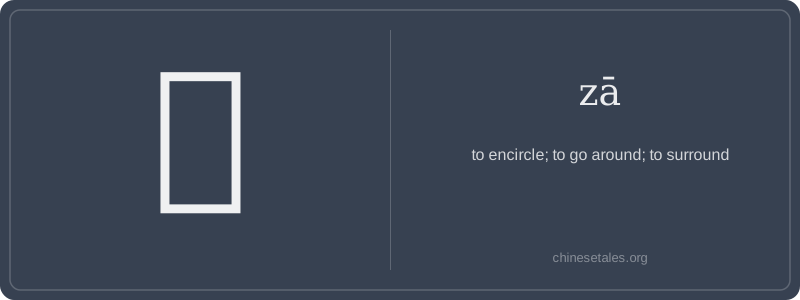
The earliest form of 匝 appears in bronze inscriptions as a simple yet brilliant pictograph: a square-like container (the ancestor of 匚) with a single curved stroke looping tightly inside it — like a wire coiled once within a frame. Over time, the loop simplified into the top horizontal stroke and the right-falling stroke (丿), while the container evolved into the standard 匚 radical. The five strokes we write today — 匚 plus the three internal strokes (一、丿、丨) — preserve that original image: enclosure + single circuit. Even its seal script form looks like a closed box with a gentle, decisive arc crossing its interior.
This visual logic directly shaped its meaning: from ‘one full turn inside a boundary’ to ‘one complete circuit around an object’. In classical texts like the *Book of Songs* and Cao Cao’s poetry, 匝 was never abstract — it measured real motion: chariots circling altars, birds orbiting trees, soldiers marching perimeters. Its persistence in modern technical terms (e.g., transformer coils) proves how deeply its ‘single-turn’ essence resonates — not as metaphor, but as unit of precision. The character doesn’t describe coverage; it counts completion.
Imagine 匝 as a minimalist artist’s sketch of something tightly wound — not a rope, not a snake, but the *idea* of complete enclosure. Its core feeling is closure, full rotation, and snug containment: think wrapping tape around a box once, walking one full lap around a track, or a vine circling a pole exactly once. It’s not vague ‘around’ like 在旁边; it’s precise, countable, and physical — always implying a single, unbroken circuit.
Grammatically, 匝 is almost exclusively a measure word (like ‘loop’ or ‘turn’) for circular motion or encirclement, used with verbs like 绕 (to circle) or 转 (to rotate). You’ll see it in constructions like ‘绕三匝’ (circle three times), never as a standalone verb. Learners often mistakenly try to use it like 包 (to wrap) or 围 (to surround) — but 匝 doesn’t mean ‘to surround’ in the sense of covering or enclosing space; it means ‘to complete one full circuit *around* something’. It’s about the path, not the barrier.
Culturally, 匝 carries classical weight: it appears in the famous line from Cao Cao’s poem — ‘绕树三匝,何枝可依?’ (Circling the tree three times — on which branch may I rest?). Here, the repetition isn’t mechanical — it’s restless, searching, almost anxious. Modern usage is rare outside literary or technical contexts (e.g., engineering: ‘线圈匝数’ — number of coil turns), so learners rarely encounter it in daily speech — making its elegant precision all the more striking when it does appear.