匚
Character Story & Explanation
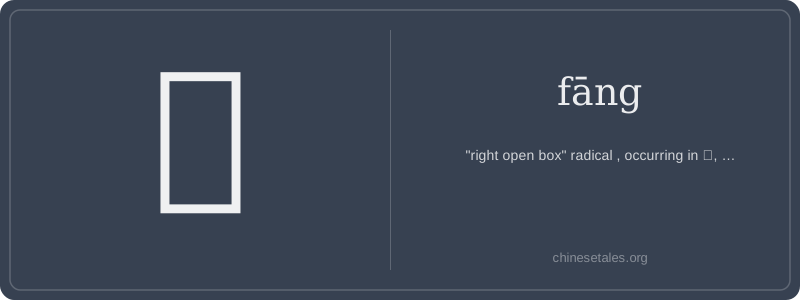
Carve this into your mind: over 3,000 years ago, in Shāng dynasty oracle bone inscriptions, 匚 began as a simple, elegant outline — a rectangular frame with the right side deliberately left open, drawn with a single fluid motion. Archaeologists found it etched beside characters for ‘store’, ‘hide’, or ‘distribute’, always suggesting a receptacle used by ritual officials to hold ceremonial grain or bronze tokens. By the Warring States period, scribes streamlined it: the rounded corners sharpened, the open right side became a clean downward diagonal, and the top stroke shortened — evolving into today’s crisp, minimalist two-stroke form.
This ‘open-box’ shape didn’t just represent storage — it encoded a philosophical nuance. In early texts like the *Rites of Zhou*, containers marked with 匚-like symbols denoted items reserved for state rites, not daily use — implying sacred containment *and* ritual accessibility. Even in modern usage, that duality lingers: 区 (qū, ‘district’) isn’t just any area — it’s an administratively bounded zone; 医 (yī) doesn’t just mean ‘healing’ — it implies medicine systematized, categorized, and made available. The radical’s open-right side whispers: ‘What’s inside is held *for purpose*, not locked away.’
Meet 匚 (fāng) — not a standalone word you’ll use in conversation, but a silent architect behind dozens of common characters. Visually, it’s just two strokes: a short horizontal line on top, then a downward-rightward stroke that curves slightly inward — like a box with its right side open. In ancient times, this wasn’t abstract; it was a pictograph of a storage container viewed from the front, designed to hold things securely yet accessibly. That ‘open-right’ shape isn’t accidental — it signals containment *with intention*: something is placed inside and can be retrieved, not sealed forever.
Grammatically, 匚 never stands alone as a word or morpheme — it’s strictly a radical (bùshǒu), appearing only as a component on the left side of compound characters like 区 (qū, ‘area’), 医 (yī, ‘medical’), and 匹 (pǐ, ‘a measure for horses or fabric’). Notice how each of these implies boundedness or classification: an area is a defined space; medical practice ‘contains’ healing knowledge; a ‘匹’ measures a discrete, standardized unit. Learners sometimes misread 匚 as part of the character’s meaning — but no: it’s purely structural scaffolding, guiding how we categorize and look up these characters in dictionaries.
Culturally, 匚 embodies a subtle Chinese design principle: functional enclosure. Unlike Western boxes that emphasize full closure (think lids and locks), 匚 suggests openness-with-purpose — like a shop counter where goods are displayed but still under control. A common mistake? Confusing it with the numeral 2 (二) or the character 工 (gōng, ‘work’) — but those have flat, parallel horizontals, while 匚 has one flat top and one slanted, embracing stroke. It’s less about what’s inside, and more about *how* space is organized around it.