匕
Character Story & Explanation
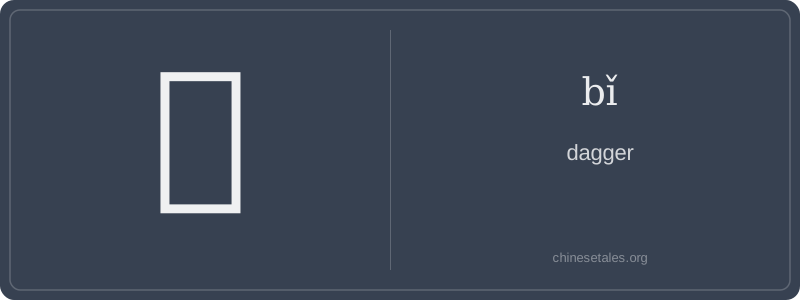
The earliest form of 匕 appears in oracle bone inscriptions (c. 1200 BCE) as a clear pictograph: a short, curved blade with a distinct hilt — drawn as a downward-sweeping arc ending in a hook, like a miniature sickle or ceremonial knife. Over centuries, the bronze script simplified the curve; in seal script, it became two clean strokes — a falling diagonal (㇇) representing the grip, and a soft, rightward-curving hook (乚) mirroring the blade’s taper. By the clerical script era, the shape locked into today’s minimalist two-stroke form — still unmistakably blade-like if you tilt your head.
This wasn’t just any knife: in Shang and Zhou texts, 匕 referred specifically to the small, handleless sacrificial dagger used to cut meat offerings on ancestral altars — a tool so sacred it appeared in divination records and bronze vessel inscriptions. The Shuōwén Jiězì (100 CE) defines it as 'a utensil for cutting cooked meat', linking it to ritual purity. Its visual economy — just two strokes capturing both function and reverence — reflects early Chinese writing’s genius: maximum meaning, minimum ink.
At first glance, 匕 (bǐ) looks deceptively simple — just two strokes — but it’s a tiny time capsule. It means 'dagger' or 'small knife', and carries the sharp, precise energy of a blade: compact, functional, and slightly dangerous. Unlike modern kitchen knives (刀), 匕 evokes ancient ritual bronze daggers used in Shang dynasty ceremonies — not for cooking, but for sacrifice, divination, or status. You’ll rarely see it alone in speech; it’s mostly a radical or fossilized element in compound words.
Grammatically, 匕 almost never stands alone as a word in modern Mandarin — you won’t say 'I have a bǐ' like 'I have a knife'. Instead, it appears inside characters (like 北 běi 'north', which originally showed a person facing away, holding a 匕) or in classical compounds like 匕首 (bǐshǒu, 'dagger'). Learners sometimes misread it as a punctuation mark or confuse it with '7' or 'r', but remember: it’s not a numeral or letter — it’s a stylized blade pointing down-left, with the first stroke (㇇) as the hilt and the second (乚) as the curved blade.
Culturally, 匕 hints at how deeply objects were embedded in early Chinese cosmology: even a small dagger had ritual weight. Modern learners often overpronounce it as 'bī' (first tone) due to its visual simplicity, but it’s always bǐ (third tone). And while it’s absent from HSK, spotting 匕 helps decode dozens of characters — like 化 (huà, 'to transform'), where 匕 + 人 suggests 'a person changed by a ritual object'.