匑
Character Story & Explanation
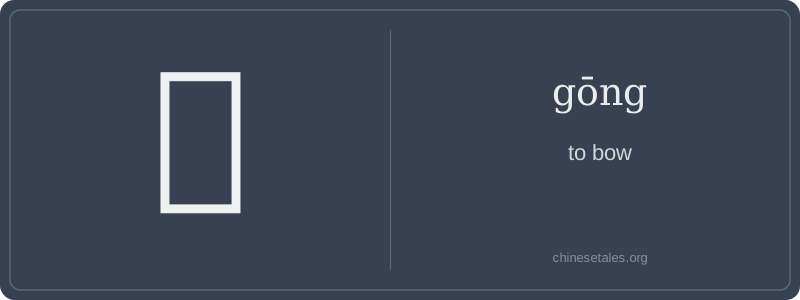
The earliest form of 匑 appears in late Western Zhou bronze inscriptions as a vivid pictograph: a kneeling human figure (the radical ⺼, representing the body) with arms bent sharply downward and head lowered — not just bowed, but *offering* something, perhaps a jade tablet or tribute. Over centuries, the limbs simplified into two curved strokes (⺈ + ), while the kneeling posture solidified into the lower component (厶), which originally depicted folded legs. By the Small Seal script, the character had crystallized into its current shape: a top-heavy upper part suggesting bowed head and arms, resting atop the compact, closed shape of 厶 — symbolizing humility, containment, and ritual closure.
This visual logic directly shaped its meaning: 匑 never meant mere courtesy — it encoded a cosmological act. In early texts like the Zuo Zhuan, 匑 appears in contexts where rulers or ministers bow *not just to people, but to Heaven’s mandate*. The character’s structure — upper body yielding, lower body grounded — mirrors the Confucian ideal of harmony between Heaven (top) and Earth (bottom), with the human self mediating through ritual gesture. Even its pronunciation gōng echoes the resonant hum of temple bells during ceremonial bows — a sonic reminder that reverence was, and still is, embodied sound and posture.
Let’s be honest: 匑 (gōng) is a ghost character — elegant, ancient, and nearly extinct in modern speech. It means 'to bow' in the deepest, most ritual sense: not just a quick nod, but a full, reverent lowering of the body — head, torso, even knees — to express awe, submission, or profound respect. Think Confucian salutes before ancestors or scholars kowtowing before imperial decrees. Its feeling isn’t casual; it’s solemn, hierarchical, and charged with moral weight.
Grammatically, 匑 is almost never used alone today. You won’t hear someone say ‘I bow’ using 匑 as a verb in daily Mandarin. Instead, it survives exclusively in classical compounds and literary set phrases — like 匑敬 (gōng jìng, ‘reverent respect’) or 匑誠 (gōng chéng, ‘sincere devotion’). When you *do* see it, it’s always paired, always formal, and always elevated — never in texting, never in slang. Learners mistakenly try to substitute it for the common verb 鞠躬 (jū gōng), but that’s like swapping ‘thou’ for ‘you’ in modern English: technically related, but utterly out of register.
Culturally, 匑 carries the quiet gravity of pre-modern ritual propriety. It’s the character you’d find carved on Ming dynasty ancestral tablets or quoted in the Book of Rites. A common mistake? Assuming it’s interchangeable with 恭 (gōng, ‘respectful’), which looks similar but functions as an adjective — not a verb — and lacks the physical act of bowing. Remember: 匑 is about *motion*, not mood.