匏
Character Story & Explanation
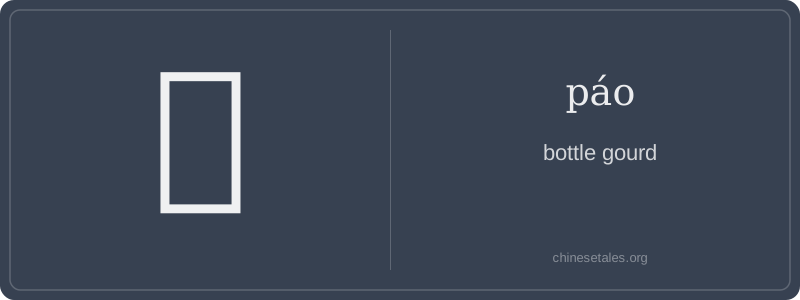
The earliest form of 匏 appears in bronze inscriptions as a stylized drawing of a gourd plant: a curving vine with two swollen, asymmetrical lobes (the fruit) and a constricting waist — all enclosed by a sweeping arc representing the vine’s embrace. Over time, the vine simplified into the radical 勹 (bāo, ‘to wrap’), while the gourd’s shape condensed into the right-side component 卯 (mǎo), originally a phonetic hint but later stylized beyond recognition. The 11 strokes emerged organically: three for 勹, eight for 卯 — each stroke echoing the gourd’s contours: the opening curve, the tapering neck, the rounded swell, the subtle dip at the waist.
This character wasn’t born abstract — it was drawn from life in Shang dynasty gardens. By the Warring States period, 匏 appears in the *Book of Songs* (Shījīng) describing ceremonial wine vessels carved from dried gourds. Its visual ‘wrapping’ shape (勹) perfectly mirrors how the vine coils around the fruit — nature captured in line and curve. Later, Daoist texts praised the 匏 for its emptiness (‘hollow inside, yet useful’), linking form directly to philosophical virtue. Even today, calligraphers linger on its balanced asymmetry — a reminder that meaning grows not from perfection, but from organic truth.
Imagine holding a dried bottle gourd — light, hollow, slightly curved, with a narrow neck and bulbous belly. That’s the visceral feeling of 匏 (páo): not just ‘bottle gourd’ as a botanical term, but a culturally resonant object that evokes ancient craftsmanship, rustic simplicity, and quiet utility. In classical Chinese, 匏 was never just produce — it was one of the ‘Eight Treasures’ in ritual contexts and a symbol of humility (since it floats gently on water, unlike heavy jade or bronze). You’ll almost never see it in modern spoken Mandarin; it’s literary, poetic, or technical — think classical poetry or botany texts.
Grammatically, 匏 functions exclusively as a noun, usually unmodified — no measure words like 个 are used with it in classical style (you’d say 匏瓜, not 一个匏). Learners sometimes misread it as ‘spoon’ or ‘pot’ due to the 勹 radical (which suggests ‘enveloping’), but 匏 is *not* a container you hold in your hand — it’s the *raw material*: the gourd itself, before carving or drying. It’s also easy to confuse with 瓢 (piáo), which *is* the ladle *made from* a 匏 — a crucial semantic distinction: one is the fruit, the other is the tool.
Culturally, 匏 appears in the famous Confucian phrase ‘匏瓜不食’ (páo guā bù shí) — ‘a bottle gourd does not eat’ — meaning someone talented but unused, like a gourd hanging idly on the vine. This metaphor only works because 匏 is inherently inert, humble, and waiting for purpose. Mistake it for 瓢 or 葫, and you lose centuries of layered symbolism. It’s not in HSK because it’s rare in daily life — but when it appears, it’s always doing heavy cultural lifting.