勋
Character Story & Explanation
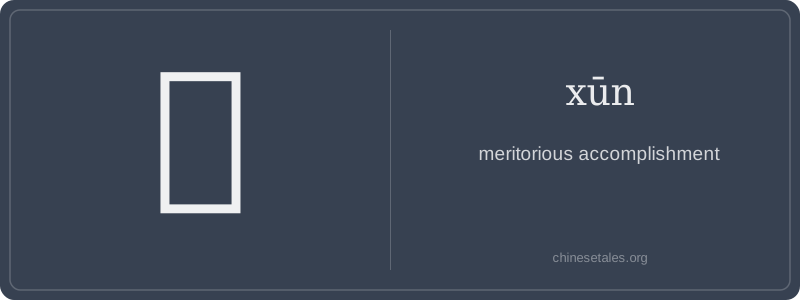
The earliest form of 勋 appears in bronze inscriptions of the Western Zhou dynasty (c. 1046–771 BCE) as a compound pictograph: a stylized ‘halberd’ (戈, gē) above a ‘strength’ symbol (力). The halberd represented martial prowess; the 力 beneath anchored it in human effort—not divine favor or birthright. Over centuries, the top evolved from 戈 into the simplified component 旬 (xún), which phonetically approximates the sound xūn while retaining visual rhythm. The bottom 力 remained unchanged: nine strokes total, with the final stroke boldly sweeping right—like a decisive strike sealing one’s legacy.
This character crystallized during the Warring States period as states competed for talent: rulers awarded 勋 to strategists and generals whose deeds literally shifted borders. The Book of Rites (Lǐjì) notes that ‘true 勋 arises when virtue and action unite’—a philosophical seal on its meaning. Visually, the 旬 (xún) top hints at cyclical time (a ten-day period), suggesting merit endures across eras; the 力 below grounds it in bodily commitment. No wonder today’s ‘national hero’ plaques always feature this character—it’s a 3,000-year-old stamp of earned dignity.
At its heart, 勋 (xūn) carries the weight of earned glory—not inherited status, not luck, but hard-won merit. Think of it as the Chinese linguistic equivalent of a gold medal engraved with sweat: it’s reserved for exceptional contributions to the nation, military, or society. You won’t hear it in casual chat ('I got coffee' → no 勋); it lives in formal registers—awards ceremonies, official commendations, historical accounts. Its core feeling is solemn, dignified, and deeply collective: this isn’t personal bragging—it’s recognition that serves a larger ideal.
Grammatically, 勋 is almost never used alone. It appears only in compounds like 功勋 (gōng xūn, 'meritorious deed') or 勋章 (xūn zhāng, 'medal'). It’s a noun root, never a verb or adjective—and crucially, it cannot be modified by degree adverbs like 很 or 非常. Saying *‘很勋’ is as ungrammatical as saying *‘very medal’ in English. Learners sometimes mistakenly treat it like a standalone adjective (e.g., *‘他很勋’), forgetting it’s a fossilized honorific noun bound to institutional recognition.
Culturally, 勋 evokes the Confucian ideal of ‘virtue made visible’: moral excellence proven through action, not rhetoric. In modern usage, it’s tightly linked to state-bestowed honors—like the August 1st Medal or the Friendship Medal. A subtle trap? Don’t confuse it with 功 (gōng, ‘achievement’) alone: 功 can be everyday effort (‘study hard’), but add 勋 and you’ve crossed into national-hero territory. Also, note its radical 力 (lì, ‘strength’) — not a decorative flourish, but a visual vow: true merit demands exertion.