劢
Character Story & Explanation
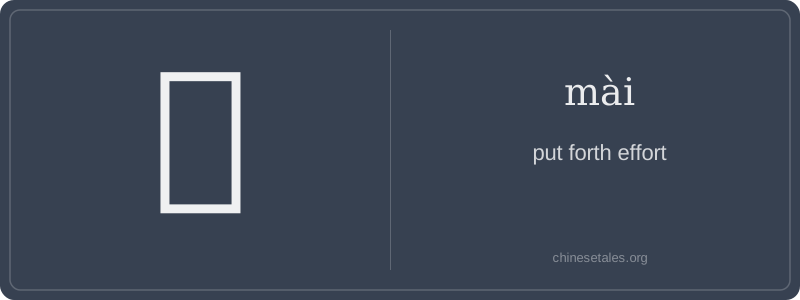
Look closely at 劢: two strokes on top (一 and 丶), then the radical 力 (lì, 'strength') below. In oracle bone script, this character began as a stylized depiction of a person straining forward — arms extended, torso bent, feet planted — with an emphasis on *directional force*. Over time, the upper part simplified from a complex gesture into the minimalist 万 (wàn) shape (not the numeral 万!), which here acts purely as a phonetic component (mài), while 力 remained the semantic heart. The modern form crystallized in seal script: clean, uncluttered, and utterly purposeful — five strokes, no waste.
This visual economy mirrors its classical meaning: in the Shuōwén Jiězì (121 CE), 劢 is defined as 'to exert oneself fully toward a goal' — not brute force, but directed will. It appears in Tang dynasty stele inscriptions praising officials who '励精图治,劢志不怠' (exerted meticulous governance, their resolve never slackening). Its rarity today isn’t decline — it’s preservation: 劢 survives precisely where effort must feel solemn, intentional, and deeply human.
劢 (mài) is a compact powerhouse — just five strokes, yet it packs the full weight of earnest, focused effort. Think less 'I’ll try' and more 'I’m leaning in with both hands and all my will.' It’s not casual exertion like 努力 (nǔlì), nor mechanical labor like 干 (gān); 劢 evokes deliberate, almost reverent striving — the kind you’d see in a calligrapher’s steady hand or a scholar grinding ink at dawn. It carries quiet dignity, not sweat.
Grammatically, 劢 is almost never used alone today; it appears exclusively in formal compounds like 勉劢 (miǎn mài) or 激劢 (jī mài). You won’t find it as a verb in modern speech ('I 劢 hard') — that would sound archaic or poetic. Instead, it functions like a semantic anchor: in 勉劢, it sharpens 勉 (to encourage) into 'earnest encouragement'; in 激劢, it transforms 激 (to stir) into 'deeply stirring, rousing effort.' Think of it as the 'intensifier stroke' for moral or spiritual vigor.
Culturally, 劢 belongs to the Confucian lexicon of self-cultivation — it’s the inner push behind 'cultivating virtue' (修身), not the outer act. Learners often misread it as 砺 (lì, to whet) or 励 (lì, to encourage), missing its rare, refined tone. Also beware: its pinyin mài sounds identical to 脉 (mài, pulse) — a delightful homophone hint: true effort isn’t loud; it’s the steady, vital pulse beneath action.