勰
Character Story & Explanation
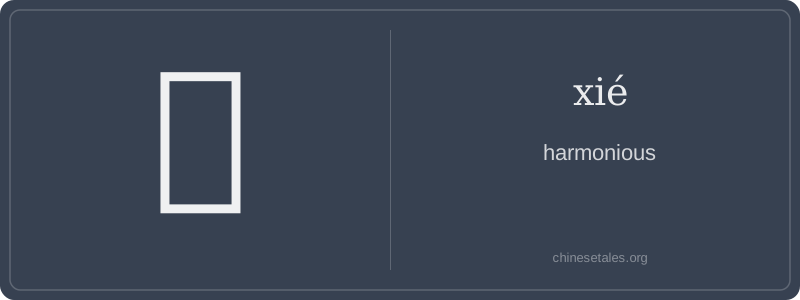
The earliest form of 勰 appears in bronze inscriptions as a complex composite: three ‘mouths’ (口) stacked vertically — symbolizing multiple voices — flanked left and right by ‘hands’ (又), and anchored below by ‘strength’ (力). Over centuries, the three mouths fused into the top component 協 (a variant of 协), the hands evolved into the left-side 羊 (sheep, originally stylized hands + ‘yáng’ sound clue), and 力 remained steadfast at the bottom. By the Han dynasty, the structure solidified into today’s 15-stroke form: 羊 + 力 + 口 + 口 + 口 — a visual chant of collective voice powered by strength.
This character first bloomed in Liu Xie’s 6th-century literary masterpiece *The Literary Mind and the Carving of Dragons* (文心雕龙), where he praises ‘the harmonious interplay of thought and language’ (文質彬彬,然後協). There, 勰 wasn’t about quiet agreement — it was the dynamic, strenuous alignment of meaning, rhythm, and moral intent. Its form mirrors its philosophy: no single element dominates; each mouth speaks, each hand acts, and 力 grounds them all — harmony as shared labor, not silent consensus.
勰 (xié) isn’t just ‘harmonious’ — it’s *orchestrated* harmony: the kind that emerges only when multiple forces consciously align, like musicians tuning before a symphony or ministers coordinating state policy. Its core feeling is active, intentional unity — not passive peace, but collaborative precision. You’ll almost never hear it in casual speech; it lives in formal writing, classical allusions, and compound words where balance, coordination, and mutual reinforcement are central.
Grammatically, 勰 functions exclusively as a literary adjective or verb root within compounds (e.g., 协同 xié tóng ‘to coordinate’), never standalone. Learners sometimes try to say *‘wǒ hěn xié’* (‘I’m very harmonious’) — but that’s nonsensical in Chinese. It doesn’t describe personal temperament like 和 (hé); instead, it modifies relationships between entities: plans, policies, efforts, or natural forces. Think of it as the ‘harmony’ of engineering, not emotion.
Culturally, 勰 carries Confucian-legalist weight: harmony achieved through disciplined cooperation, not mere absence of conflict. It appears in historical texts describing bureaucratic synergy or cosmic order — and today, in official documents about ‘coordinated development’. A common mistake? Assuming it’s interchangeable with 协 (xié), its simplified sibling — but 协 is broad and functional (‘cooperate’), while 勰 is rare, elevated, and poetic. Using 勰 where 协 suffices sounds archaic or pretentious — like quoting Shakespeare at a coffee run.