勯
Character Story & Explanation
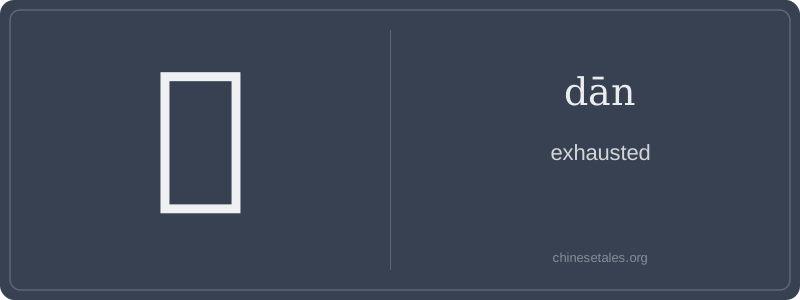
The earliest form of 勳 appears in late Warring States bamboo texts, not oracle bones — and its structure tells a vivid story. The left side is 力 (lì, ‘strength’ or ‘effort’), a radical representing muscular exertion, while the right side is 単 (dān), an ancient variant of 亶 (dǎn), meaning ‘sincere’, ‘abundant’, or ‘thorough’. In bronze inscriptions, 単 resembled a hand holding a grain stalk — symbolizing fullness, earnestness, and sustained output. Over centuries, the grain stalk simplified into the modern 単, and the compound evolved visually into today’s 勳: two components fused into one tight, downward-leaning glyph that literally reads ‘effort fully expended’.
This visual logic shaped its semantic journey. In early texts like the *Zuo Zhuan*, 勳 described the weariness of loyal ministers who labored tirelessly for the state — exhaustion born of devotion, not laziness. By the Tang dynasty, poets like Du Fu used it to depict the physical toll of virtue: ‘筋力勳’ (jīnlì dān) — ‘sinews and strength utterly spent’. Its rarity today isn’t due to obsolescence, but reverence: it’s reserved for moments when exhaustion becomes a testament — not a complaint.
Think of 勯 (dān) as Chinese’s linguistic equivalent of the ‘sweat-dripping-from-the-brow’ emoji — not just tired, but *physically spent*, like you’ve just sprinted up five flights of stairs while carrying a piano. It conveys visceral, muscular exhaustion — the kind that makes your limbs tremble and your breath hitch. Unlike common synonyms like 累 (lèi) or 疲惫 (píbèi), 勳 is literary, rare, and emotionally charged: it appears in classical poetry and modern essays to evoke profound depletion, often with moral or existential weight.
Grammatically, 勳 functions almost exclusively as a stative adjective — never as a verb or adverb — and typically appears after the subject and before descriptive predicates or complements. You’ll rarely see it in isolation; instead, it pairs with intensifiers (如 极了, 得不行) or verbs of state (如 感觉, 显得). Example: ‘他跑完马拉松后,脸色惨白,四肢勳极了’ — note how it modifies the physical state, not the action itself. Learners often mistakenly try to use it predicatively without support (e.g., ‘他勳’), but native speakers always contextualize it: ‘他看起来勳’ or ‘累得勳’.
Culturally, 勳 carries an almost tragic dignity — it’s the exhaustion of the righteous laborer, the scholar who studied all night, the mother who nursed through fever. It implies effort *worth* exhaustion. A common learner trap is overusing it in casual speech; it sounds archaic or overly dramatic if dropped into texting or chat. Also, beware: its pronunciation dān rhymes with ‘don’ — not ‘dan’ as in ‘danger’ — so mispronouncing it risks sounding like you’re saying ‘dān’ (a different character meaning ‘single’ or ‘simple’).