勚
Character Story & Explanation
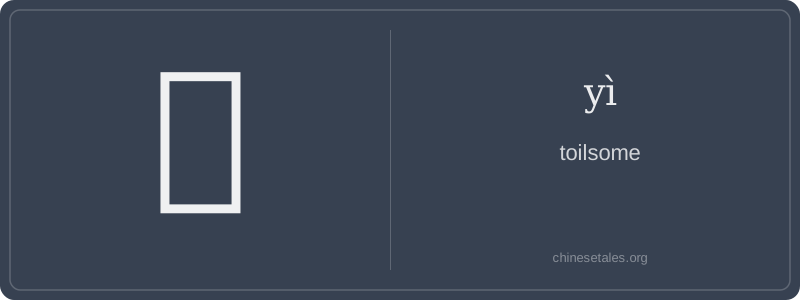
Oracle bone and bronze inscriptions show no direct precursor to 勷 — it’s a later invention, likely Han dynasty or earlier, crafted deliberately from existing components. The left side, 弋 (yì), was originally a pictograph of a tethered arrow or hunting tool — symbolizing precision, control, and purposeful action. The right side, 力 (lì), is the 'strength' radical, unmistakably depicting a bent arm applying force. Over centuries, 弋 simplified from a complex arrow-with-cord glyph into its modern three-stroke form (一 丿 丶), while 力 retained its muscular curve — together forming a compact, balanced ideograph: 'purposeful strength applied with strain'.
This visual logic cemented its meaning early: in the 3rd-century text Guangya, 勷 is glossed as 'difficult to accomplish' — already emphasizing mental and physical exertion combined. By the Tang dynasty, poets used it to describe the painstaking refinement of verse ('勷思' — 'toiling thought'), and in Ming-Qing novels, it described the exhausting logistics of imperial examinations. Its form never changed dramatically — unlike many characters, it avoided major script reforms — because its composition was so semantically tight: 弋 + 力 = effort guided by intent, not brute force alone.
勷 (yì) is a rare, literary character meaning 'toilsome', 'arduous', or 'laborious' — but don’t mistake it for everyday exhaustion; it carries the weight of noble, sustained effort, like the sweat of scholars copying sutras by lamplight or generals planning campaigns through the night. It’s not colloquial: you’ll almost never hear it in speech or pop culture — it lives in classical poetry, historical texts, and formal essays where dignity and perseverance are at stake.
Grammatically, 勷 functions almost exclusively as an adjective before nouns (e.g., 勷事 yì shì — 'arduous affairs') or in fixed four-character idioms (chengyu). It never stands alone as a verb or predicate — unlike 劳 (láo, 'to labor'), you can’t say '他勷' ('He is toilsome'). Learners often wrongly treat it like a verb or overuse it trying to sound 'literary'; in reality, native speakers reach for 辛苦 (xīnkǔ), 艰巨 (jiānjù), or 艰辛 (jiānxīn) instead. Its rarity means even many educated Chinese pause when reading it — a clue that this isn’t a word to memorize for conversation, but to recognize in classical contexts.
Culturally, 勷 evokes Confucian ideals of quiet endurance — not flashy heroism, but the unglamorous grit behind lasting achievement. A common mistake is confusing its pronunciation: it’s yì (fourth tone), *not* yí or yǐ — and its radical is 力 (lì, 'strength'), not 刀 or 丶. Misplacing the dot-like stroke on the right can accidentally create 意 (yì, 'idea') — a hilarious semantic leap from 'toilsome' to 'intention'!