勗
Character Story & Explanation
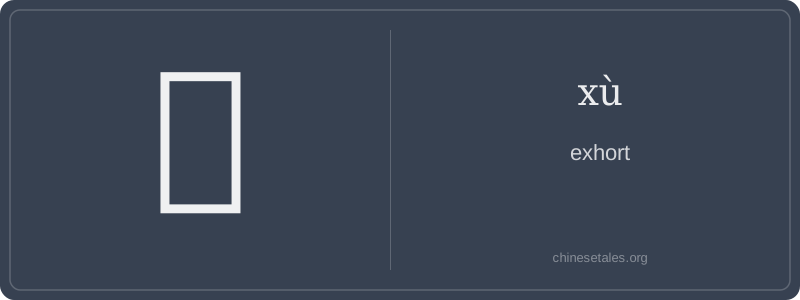
Originally carved on bronze ritual vessels during the Western Zhou dynasty, 勗 began as a composite ideograph: the left side was 力 (lì, 'strength' or 'effort'), while the right was 昜 (yáng, an early form of 陽, representing 'sunlight' or 'brightness' — symbolizing clarity and moral illumination). Over centuries, 昜 simplified into the top-heavy, angular shape we see today (the three horizontal strokes capped by a downward hook, echoing sunlight radiating downward), while 力 retained its muscular, bent-arm shape — together embodying 'exerting effort guided by moral light.' By the Han dynasty, the character stabilized in clerical script, with the upper part evolving into its current stylized form resembling a compressed sun rising over exertion.
This visual logic directly shaped its meaning: urging isn’t coercion — it’s illuminating the right path and strengthening resolve. In the Book of Rites (Lǐjì), it appears in passages advising rulers to '勗德以化民' ('exhort virtue to transform the people'), linking moral leadership with active encouragement. Unlike generic verbs, 勗 always implies ethical intention — the exhortation must align with righteousness (yì). Its enduring presence in ancestral tablets and scholarly couplets shows how deeply Chinese culture ties personal growth to respectful, principled urging.
Think of 勗 (xù) as the 'classical coach' — not the loud, sweaty kind, but the wise elder who leans in with quiet intensity and says, 'You *can* do this. Now rise to it.' Its core meaning is 'to exhort, urge, or encourage earnestly,' carrying deep moral weight: it’s not casual cheering, but a solemn, virtue-infused call to higher conduct. You’ll almost never hear it in spoken Mandarin — it lives in classical texts, formal inscriptions, and literary prose, where sincerity and moral gravity matter.
Grammatically, 勗 functions as a transitive verb, almost always followed by a noun or pronoun (e.g., 勗勉 students, 勗其子). It rarely stands alone; instead, it appears in elegant compounds like 勗勉 or 勗励. Learners often mistakenly try to use it like modern verbs such as 鼓励 (gǔlì), but that’s like wearing Song dynasty robes to a Zoom meeting — technically possible, but jarringly out of place. It doesn’t take aspect particles (了, 过, 着) and never appears in imperative sentences like '勗我!' — that would sound archaic and unnatural.
Culturally, 勗 reflects Confucian ideals of self-cultivation through gentle yet firm moral prompting. It’s the word you’d find engraved on a scholar’s inkstone or quoted in a family motto — not in WeChat chats. A common error is misreading it as xū (like 虚) due to the 'xù/xū' tone confusion, or mixing it up with 恤 (xù, 'to care for'), which shares the same pronunciation but a completely different heart-and-compassion meaning. Remember: 勗 is about *urging action*, not *feeling concern*.