勖
Character Story & Explanation
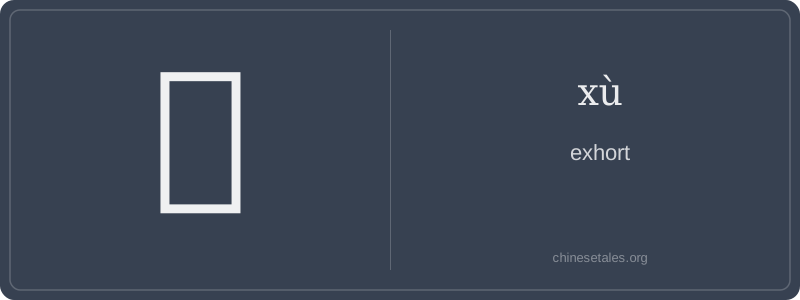
Carved over 3,000 years ago in oracle bone script, the earliest form of 勖 resembled two distinct elements: a kneeling figure (now obscured) combined with a stylized 'mouth' (口) and 'strength' (力) — suggesting speech + effort. By the bronze script era, the top evolved into the phonetic component 慮 (lǜ, later simplified to 昔), while the bottom solidified into 力, the ‘strength’ radical. Stroke by stroke, the modern form emerged: the top-left 昔 (xī) — originally depicting dried meat on a rack (symbolizing past experience/wisdom) — fused with the powerful 力 below, visually encoding ‘exhortation grounded in seasoned insight.’
This visual fusion mirrors its semantic journey: from early Zhou dynasty texts where 勖 described ritual admonition by elders, to the *Classic of Poetry*, where it appears in odes praising virtuous rulers who ‘勗哉,君子!’ (‘Exhort, O noble one!’). The character’s enduring power lies in this duality — the top (昔) whispers wisdom of the past; the bottom (力) lends it moral authority to act. Even today, when a university president writes 勖爾多士 (xù ěr duō shì — ‘Exhort you, many scholars!’) on a graduation scroll, they’re invoking that same ancient covenant between knowledge, responsibility, and gentle strength.
At its heart, 勖 (xù) is the gentle but firm hand on your shoulder — not pushing, not commanding, but urging you forward with quiet conviction. It’s the Confucian ideal of moral encouragement: uplifting others through sincere, principled counsel. Unlike common synonyms like 鼓励 (gǔlì, 'to encourage' — broad and often emotional), 勖 carries classical weight and literary precision; it implies exhortation rooted in virtue, duty, or shared ideals — think a teacher advising a disciple, or an elder admonishing a junior with benevolent gravity.
Grammatically, 勖 is almost exclusively literary and formal. You’ll rarely hear it in spoken Mandarin — it appears in written essays, historical texts, ceremonial speeches, or poetic inscriptions. It functions as a transitive verb (e.g., 勖勉 students), but never as a standalone command or in casual phrases like ‘go for it!’ Learners often mistakenly use it where 鼓励 or 激励 would fit better — a subtle but telling error that makes their writing sound archaic or stilted, like quoting Mencius at a coffee shop.
Culturally, 勖 embodies *rén* (benevolent authority): exhortation as care, not control. In classical usage, it’s frequently paired with verbs like 勉 (miǎn, 'to strive') — forming 勖勉 (xù miǎn), a compound echoing the Book of Rites. Modern learners sometimes misread its radical 力 (‘strength’) as implying force — but the character’s essence is precisely the *opposite*: strength channeled into uplift, not imposition. Its rarity outside formal contexts makes it a quiet marker of linguistic sophistication — a character you deploy like a seal on a letter of recommendation.