勒
Character Story & Explanation
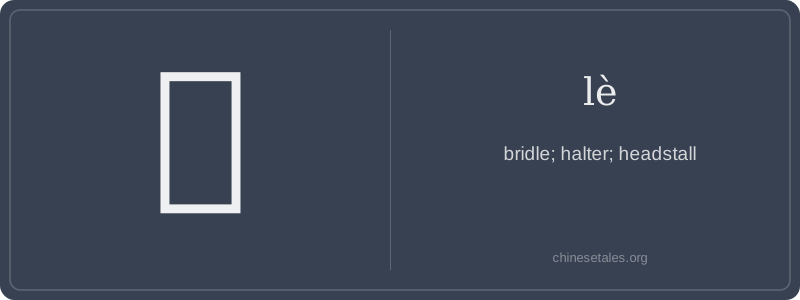
The earliest form of 勒 appears in Warring States bronze inscriptions as a composite: left side showing a stylized strip of leather (革, gé), right side depicting a hand applying pressure (later standardized into the 力 radical). Oracle bone script doesn’t contain it, but by the 4th century BCE, scribes combined 革 (rawhide, harness material) and 力 (effort) into a single ideograph representing the act of fastening a halter—each stroke mimicking the looping, tightening motion: the top horizontal strokes suggest tension, the curved 艹-like element (originally part of 革) evokes supple leather, and the final 力 anchors it in human agency.
This visual logic shaped its semantic evolution: from literal horse gear (《诗经》mentions ‘勒’ in chariot rites), to figurative control (‘勒令’, lè lìng, ‘order imperatively’), and even commemoration—since inscribing stone required pressing tools into rock, 勒石 (lè shí) became synonymous with ‘enshrining legacy’. In Tang poetry, Du Fu wrote of generals who ‘勒兵待战’ (lè bīng dài zhàn)—not merely assembling troops, but *holding them taut*, ready. The character never lost its sense of precise, authoritative restraint—like a well-fitted bridle that guides without breaking.
Imagine a horse’s head being gently but firmly guided—not by reins alone, but by a leather strap cinched around its jaw or poll: that’s the visceral feel of 勒 (lè). Its core meaning isn’t just ‘bridle’ as hardware, but the *act* of restraining, tightening, or controlling with deliberate pressure—like a rider pulling back to slow down, or a craftsman tightening a knot. Visually anchored in the 力 (lì, ‘strength, effort’) radical, it tells you this is no passive object—it’s an action requiring force and intention.
Grammatically, 勒 appears most often as a verb in classical or literary contexts: 勒马 (lè mǎ, ‘rein in the horse’) evokes urgency or sudden pause; 勒石 (lè shí, ‘engrave on stone’) implies permanence through deliberate effort. Modern learners rarely use it conversationally—but they *will* see it in idioms like 勒紧裤腰带 (lēi jǐn kù yāo dài, ‘tighten one’s belt’—figuratively, to economize), where the alternate pronunciation lēi signals physical constriction. Yes—this character has two lives: lè for control/engraving, lēi for squeezing/tightening. Mixing them up is common, but the clue is context: if something’s being *pressed*, it’s likely lēi; if it’s *controlled, recorded, or halted*, it’s lè.
Culturally, 勒 carries imperial gravitas—emperors ‘ordered inscriptions’ (勒碑) to commemorate victories, and generals ‘reined in troops’ (勒兵) before battle. Learners often misread it as ‘le’ without tones and miss the nuance—or confuse it with similar-looking characters like 勤 or 拉. Remember: 力 + 革 (leather) = leather strap exerting force. That’s the whole story in one stroke.