勍
Character Story & Explanation
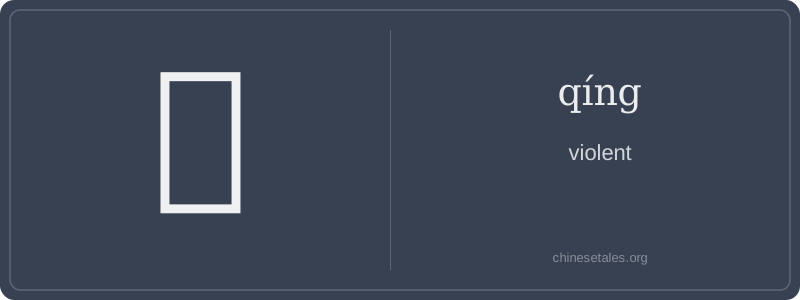
The character 勑 first appeared in late Warring States bamboo slips and early Han dynasty inscriptions. Its earliest form fused two elements: 青 (qīng, originally depicting a plant sprouting — later phonetic) atop 力 (lì, ‘strength’, pictograph of a ploughing arm with sinewy muscle). This wasn’t arbitrary: the scribes chose 青 not for color, but for its ancient pronunciation *kʰleŋ*, which closely matched the intended *kʰleŋ* (later qíng) — making it a classic phono-semantic compound. Over centuries, the top element standardized into the modern 青 shape (with its distinctive ‘life’ radical 生 inside), while 力 retained its robust, angular stroke — visually anchoring the meaning: ‘force so intense it bursts forth like green life breaking stone’.
By the Tang dynasty, 勑 had crystallized as a literary intensifier for natural phenomena — especially wind, rain, waves, and fire — appearing in Du Fu’s storm poems and Li Bai’s frontier verses. Its semantic evolution reflects a deeper Chinese worldview: violence isn’t inherently evil, but one expression of *qi* (vital energy) at its most concentrated. In the *Huainanzi*, 勑 wind symbolizes cosmic imbalance; in Ming novels, 勑火 marks divine retribution. Crucially, the character never acquired moral connotations — unlike 暴 (bào), which implies cruelty, 勑 remains amoral, elemental, and majestic.
Think of 勑 (qíng) not as a dictionary definition like 'violent', but as the Chinese linguistic equivalent of a thunderclap — sudden, overwhelming, and almost physical in its intensity. It doesn’t describe routine anger or even ordinary fury; it evokes raw, uncontrolled force — like a typhoon tearing through a rice field or a warhorse bolting mid-battle. Unlike English ‘violent’, which can be abstract (‘violent disagreement’), 勑 is nearly always literary, poetic, or archaic, and almost exclusively modifies nouns (e.g., 勑风, 勑雨) — never verbs or people directly. You’ll never hear someone say ‘He is 勑’; instead, you’ll read ‘勑风卷地’ (‘fierce wind sweeps the ground’) in classical poetry.
Grammatically, 勑 functions only as an attributive adjective — always preceding a noun, never standing alone or taking degree adverbs like *hěn* (very). Learners often mistakenly try to use it predicatively (*Tā hěn 勑*) or confuse it with common modern synonyms like 猛 (měng) or 暴 (bào). But 勑 has zero colloquial presence: it’s a fossilized word preserved in set phrases, idioms, and historical texts — like encountering ‘thou’ or ‘verily’ in modern English speech.
Culturally, 勑 carries a Daoist-Buddhist resonance: its violence isn’t moral condemnation, but nature’s untamable power — indifferent, awe-inspiring, beyond human judgment. Mistaking it for a synonym of 残暴 (cánbào, ‘brutal’) misses this nuance entirely. And yes — learners *always* misread it as qīng (like 青) due to the shared -íng sound and visual similarity to 青 + 力; that single tone shift flips your sentence from ‘fierce rain’ to ‘green strength’ — nonsense that’ll make native readers blink twice.