劾
Character Story & Explanation
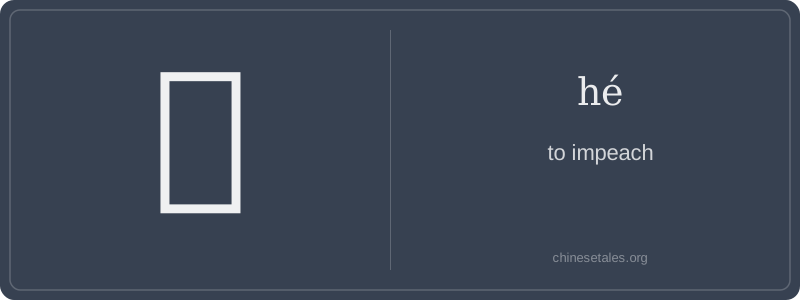
The earliest form of 劾 appears in bronze inscriptions from the Warring States period—not as a pictograph, but as a compound ideograph. Left side: 曷 (hé), originally a phonetic component meaning ‘what?’ or ‘why?’, later serving purely for sound. Right side: 力 (lì), the ‘strength’ or ‘effort’ radical—visually two strokes forming a bent arm with muscle tension. In seal script, 曷 was more elaborate (a mouth 口 atop a ‘helmet’ or ‘cover’ component), but by clerical script, it simplified into today’s top half: a dot, then horizontal stroke, then ‘lid’ shape (匚-like) over ‘ten’ (十). The 力 radical stayed robust—anchoring the character in action, not abstraction.
This visual pairing—‘why?’ + ‘force’—crystallized into ‘to formally challenge why someone in power should remain in office.’ By the Han dynasty, censors (yùshǐ) wielded 劾 like a ritual weapon: writing memorials to impeach ministers for dereliction, greed, or disloyalty. The Book of Han records dozens of such cases—e.g., ‘王吉劾丞相失职’ (Wáng Jí hé chéngxiàng shīzhí), where the censor directly named the prime minister’s failure. Crucially, 劾 wasn’t just verbal—it implied documentation, evidence, and consequence. Its force lies not in shouting, but in the quiet, unblinking act of signing your name to a charge against authority.
Imagine a Han dynasty imperial censor, sleeves rolled up, standing before the emperor’s throne—not with flattery, but with a scroll clenched in one hand and a finger jabbing downward like a gavel: *hé!* That’s 劾—no gentle suggestion, no diplomatic hint. It’s formal, high-stakes, institutional accusation: to impeach an official for misconduct. This isn’t ‘criticize’ or ‘complain’; it carries legal weight, bureaucratic gravity, and moral authority. You’ll almost never hear it in casual speech—it lives in historical dramas, academic papers on Ming-Qing governance, or modern anti-corruption reports.
Grammatically, 劾 is a transitive verb that *requires* a direct object (the person being impeached) and often appears in classical or semi-formal syntax: *yǒu rén shàng shū hé zhī* (someone submitted a memorial to impeach him). Unlike verbs like 批评 (pīpíng), 劾 doesn’t take aspect particles (了, 过) lightly—it resists colloquialization. Learners sometimes misread it as *hài* (like 害) due to visual similarity, or overextend it to mean ‘accuse’ broadly—but 劾 implies *official, documented, hierarchical accountability*, not street-level blame.
Culturally, 劾 embodies Confucian ‘rectification of names’ (zhèngmíng): restoring moral order by holding power to account. Its rarity today makes it feel archaic—even dramatic—but when used in modern headlines (e.g., ‘监察委依法劾罢某官员’), it signals gravity, precedent, and procedural solemnity. Mistake it for 贺 (hè, ‘congratulate’) or 恪 (kè, ‘respectfully abide’), and you’ll accidentally congratulate a corrupt official—or demand they respectfully abide by their own impeachment!