劼
Character Story & Explanation
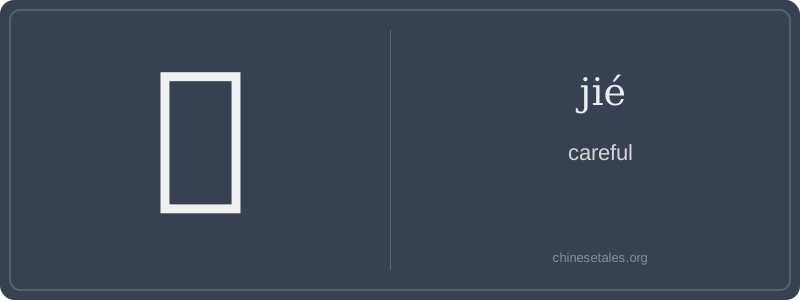
The earliest form of 劼 appears in bronze inscriptions of the Western Zhou dynasty (c. 1046–771 BCE) as a compound glyph: on the left, a simplified depiction of a person’s head and bent arm holding a measuring tool (later evolving into the ‘吉’ component), and on the right, the ‘力’ (lì, 'strength/power') radical — not as brute force, but as disciplined, directed energy. Over centuries, the left side streamlined into 吉 (jí, 'auspicious'), while the right retained 力. By the Han dynasty, the character stabilized at eight strokes: the top horizontal of 吉, then the cross and dot, followed by the downward stroke and hook of 力 — a visual metaphor: auspicious intent + focused power = conscientious care.
This meaning crystallized in early philosophical texts: in the Book of Rites (Lǐjì), 劓 is used to describe the ruler’s duty to 'be 劼 in examining laws' — implying moral rigor, not mere attention to detail. The character’s structure reinforces this: 吉 suggests positive intention, 力 suggests active commitment — together, they embody ethical vigilance. Unlike similar characters meaning 'cautious', 劼 never implies doubt or hesitation; it’s confident, deliberate, and quietly authoritative — a virtue praised in sages, not soldiers.
Imagine a meticulous Ming dynasty calligrapher, inkbrush hovering over rice paper — not writing yet, but *checking*, adjusting wrist angle, measuring spacing, inhaling slowly before each stroke. That suspended, alert stillness? That’s 劼 (jié): not just 'careful' in the sense of cautious, but deeply attentive, almost reverent precision — the kind that comes from inner discipline, not fear. It’s a literary, formal word, rarely used in casual speech or modern texting; you’ll find it mostly in classical texts, official documents, or poetic descriptions of craftsmanship.
Grammatically, 劼 functions primarily as an adjective, often modifying nouns directly (e.g., 劼慎之风 — 'a style of scrupulous caution') or appearing in parallel four-character idioms. It doesn’t take aspect particles like 了 or 过, and never stands alone as a predicate verb ('He is 力' is ungrammatical). Learners sometimes mistakenly use it like 小心 (xiǎoxīn) — but 劼 implies cultivated moral or intellectual vigilance, not everyday wariness. You wouldn’t say 劼点!('Be careful!') to warn someone crossing the street — that’s 小心 or 当心.
Culturally, 劼 carries Confucian weight: it echoes the ideal of self-cultivation through constant, quiet self-monitoring — like the scholar who inspects his own thoughts before speaking. A common mistake is overusing it in spoken contexts or confusing its tone (jié, second tone, not jiē or jiě). Also, because it shares the 力 radical with words like 努力 (nǔlì, 'to strive'), learners wrongly assume it means 'effortful' — but 劼 is about *mental restraint*, not physical exertion.