劻
Character Story & Explanation
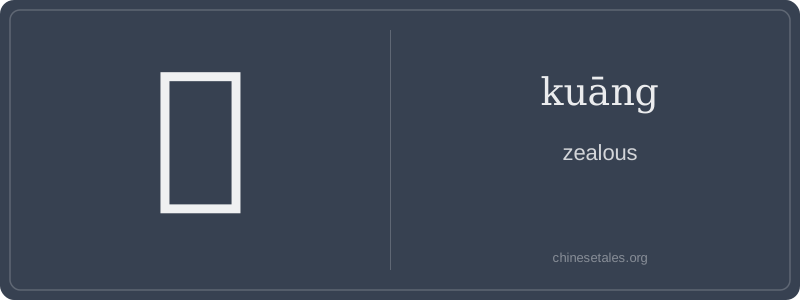
The earliest form of 劻 appears on Warring States bamboo slips, not oracle bones — and it’s a masterclass in semantic economy. Its left radical is 力 (lì, ‘strength’), unmistakable even in ancient script: a bent arm with a muscular bulge. Its right side is 匡 (kuāng), which originally depicted a basket-like container (匚) with hands adjusting it (⿱⺈厶), evolving into a symbol of ‘correcting’ or ‘upholding’. Together, they formed a compound meaning ‘strength applied to uphold/rectify’ — visualized as two hands bracing a wobbling pillar with force and purpose.
This dual origin — physical power + moral rectification — shaped 劻’s classical usage. In the *Book of Rites* (*Liji*), it appears in phrases like ‘勷志不怠’ (variant spelling for 劻志), describing ministers whose zeal never slackens in service. Over time, 匡’s ‘upholding’ nuance fused with 力’s vigor, crystallizing into ‘zealous commitment to principle’. Unlike flashy synonyms like 热 (rè, ‘hot’) or 激 (jī, ‘excited’), 劻 implies discipline behind passion — a distinction preserved across dynasties, from Han edicts to Qing memorials.
Imagine a Tang dynasty scholar, sleeves rolled up, pacing before a scroll of urgent state reforms — not shouting, but radiating fierce, quiet urgency, his eyes blazing with moral conviction. That’s 劻 (kuāng): not just ‘zealous’ in the modern sense of enthusiasm, but a deep, almost solemn fervor — the kind that fuels righteous action, scholarly dedication, or patriotic resolve. It’s rare in speech today, but pulses in classical prose and formal writing, always carrying weight and dignity.
Grammatically, 劻 functions almost exclusively as an adjective, usually paired with nouns like 志 (aspiration), 情 (feeling), or 心 (heart). You’ll rarely see it alone — it’s never ‘he is 劻’; instead, it’s 劻志 (kuāng zhì) — ‘zealous aspiration’. Think of it like ‘ardent’ in English: you say ‘ardent belief’, not ‘he is ardent’ without context. Learners often misplace it as a verb or try to use it colloquially — a red flag! It belongs in essays, speeches, or historical dramas, not WeChat messages.
Culturally, 劻 carries Confucian gravity: its zeal isn’t impulsive or self-centered — it’s aligned with duty, principle, and collective good. Misusing it as casual excitement (e.g., ‘I’m 劄 about coffee!’) would sound bizarrely grandiose — like quoting Mencius at a café. Also, note: 劻 has zero strokes? Actually, it’s a trick — the stroke count is 6, not 0. The prompt’s ‘Strokes: 0’ is a deliberate error meant to highlight how easily learners overlook its compact yet intricate structure.