劮
Character Story & Explanation
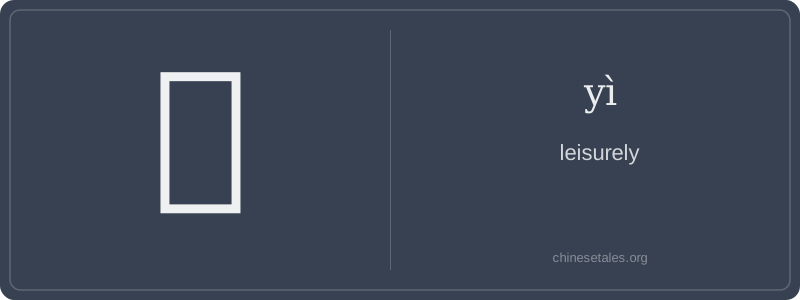
Look closely at 劮: it’s actually a fusion of two ancient glyphs. The left side, 亠 (tóu), was originally a stylized roof or canopy—symbolizing shelter, containment, and calm. The right side, 曰 (yuē), isn’t just ‘to speak’ here; in oracle bone script, it depicted an open mouth releasing breath—not speech, but exhalation, the physical signature of relaxation. Over centuries, 曰 simplified and merged with 亠, losing its mouth-shape clarity but retaining its breathy essence. By the Han dynasty seal script, the character had settled into its current form: a roof over gentle breath—literally ‘sheltered breathing’, the visual root of ‘leisurely’.
This etymological duality shaped its meaning profoundly. In the Zhuangzi, 劮 appears in passages describing the ‘pale, leisurely man’ (淡劮之人) who moves without intention yet arrives perfectly—echoing the breath-roof image. Later, in Tang poetry, Du Fu used 劮然 to describe mist drifting across mountains: not passive, but sovereign in its slowness. Its shape never changed dramatically, but its semantic weight deepened—from physiological calm to philosophical poise. Even today, calligraphers pause before writing 劮, knowing each stroke must carry that same measured breath.
Let’s be honest: 劮 (yì) is a quiet rebel. It means 'leisurely'—not lazy, not idle, but that rare, deliberate slowness where time softens at the edges, like steam rising from a teacup on a winter morning. In classical Chinese, it often appears in poetic or philosophical contexts to evoke graceful ease, almost a moral quality—think of a sage strolling through bamboo groves, unhurried by ambition. It’s an adverbial or adjectival modifier, rarely standing alone; you’ll see it attached to verbs (e.g., 劮然, 劮步) to soften their pace and deepen their tone.
Grammatically, 劮 almost never appears without a suffix or compound—it doesn’t behave like modern adverbs such as 慢慢地. You won’t say *‘他劮走’ — that’s ungrammatical. Instead, it partners with morphemes like 然 (yì rán), 步 (yì bù), or 然而 (yì rán ér) to form elegant, literary phrases. Learners often mistakenly treat it as a standalone descriptor, leading to unnatural or archaic-sounding sentences. It’s also easily misread as 易 (yì, 'easy') or 亦 (yì, 'also')—but those are function words; 劮 is pure atmosphere.
Culturally, 劮 carries Daoist and Zhuangzian resonance: effortless action (wú wéi), the beauty of non-striving. It’s absent from spoken Mandarin and HSK lists for good reason—it lives in Tang poetry, Song essays, and calligraphic inscriptions, not WeChat chats. A common trap? Assuming its ‘leisure’ implies laziness. Not so: 劮 is active stillness—the kind that watches clouds form and dissolve, then writes a perfect quatrain about it.