劬
Character Story & Explanation
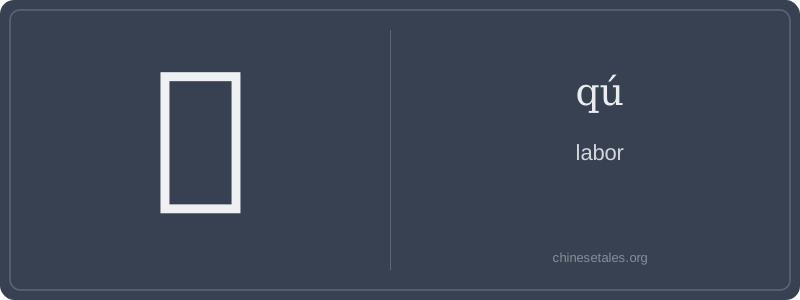
The earliest forms of 劬 appear in bronze inscriptions as a compound pictograph: a stylized human figure (often interpreted as bent at the waist) combined with a symbol for ‘strength’ or ‘effort’. Over centuries, this condensed into the modern structure: the left side 句 (jù), originally depicting a bent arm holding a tool or rope (not merely ‘sentence’), and the right side 力 (lì), ‘strength’, added as semantic reinforcement. Stroke-by-stroke, it evolved from fluid bronze curves into sharp, angular script — the first two strokes of 句 forming a tight, constricted shape mirroring physical strain, while the 力 radical anchors the whole character with grounded, muscular finality.
This visual tension — constriction + strength — perfectly mirrors its meaning development. In the *Classic of Poetry* (Shījīng), 劬 appears in odes praising mothers’ ‘qú láo’ — labor so profound it reshapes the body and soul. Later, in Tang dynasty steles and Song dynasty essays, it became synonymous with scholarly perseverance: the ink-stained fingers, the bleary eyes, the quiet sacrifice behind cultural continuity. The character doesn’t just *mean* labor — it *embodies* the posture of endurance: head bowed, back taut, strength channeled, not expended.
At its heart, 劬 (qú) isn’t just ‘labor’ — it’s *exhausting, devoted, almost sacrificial effort*, especially in service of others. Think not of factory work or coding marathons, but of a parent staying up all night nursing a feverish child, or a scholar copying bamboo slips by lamplight for decades. It carries deep classical resonance: reverence, weariness, and moral weight all rolled into one compact 7-stroke form. You’ll almost never hear it alone in modern speech — it’s a literary fossil, resurrected only in fixed, solemn compounds like 劬劳 (qú láo, 'toil and hardship') or 劬勚 (qú yì, 'arduous labor').
Grammatically, 劬 functions exclusively as an adjective or noun modifier, never as a verb — you don’t ‘do 劬’; you describe labor *as* 劬. Learners often mistakenly treat it like a standalone verb (e.g., *‘wǒ qú le yí tiān’*) — a fatal error that sounds like nonsense to native ears. Instead, it always appears paired: 劬劳、劬勚、劬心. Its radical 力 (lì, ‘strength’) anchors it firmly in physical exertion, yet its phonetic component 句 (jù, ‘sentence, clause’) hints at something more precise and deliberate — not brute force, but *measured, sustained effort*.
Culturally, 劬 is the quiet counterweight to Confucian ideals of effortless virtue (dé). It celebrates the unseen grit behind moral action — the sweat behind filial piety, the exhaustion behind scholarly mastery. Mistake it for common words like 劳 (láo) and you lose nuance: 劳 is neutral ‘work’; 劬 is *heavy, loving, bone-deep toil*. It’s rarely used outside formal writing, poetry, or classical allusions — so spotting it feels like finding a seal on an ancient scroll.