劦
Character Story & Explanation
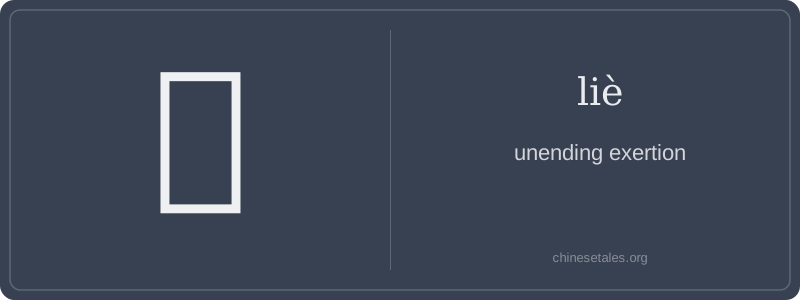
The earliest form of 劦 appears in bronze inscriptions as three identical 力 (lì, 'strength') glyphs stacked vertically or arranged in a triangular cluster—visually shouting 'triple power!' This wasn’t decorative: ancient scribes used repetition to intensify meaning, and three was the ultimate symbol of completeness and persistence. Over time, the top two 力 simplified into the two horizontal strokes and the angled hook above, while the bottom 力 retained its full form—evolving into today’s six-stroke structure: two short lines, a diagonal hook, then the complete 力 radical below.
This triple-force imagery directly birthed its core meaning: not mere effort, but *relentless, cumulative, collective exertion*. In the *Shuōwén Jiězì* (121 CE), Xu Shen defined it as 'three forces acting together without ceasing'—echoing Daoist and Confucian ideals of harmonious, sustained action. Though rarely used after the Han dynasty, it survived in literary echoes, like Liu Zongyuan’s Tang-era essays praising officials who governed with 劦心 ('unflagging heart'), linking visual repetition to moral stamina.
Imagine three exhausted farmers, shoulders hunched, muscles burning, pushing a massive stone cart up a steep mountain path—each step grinding, each breath ragged, yet they never stop. That’s 劦 (liè): not just 'effort', but *unending*, almost stubborn exertion—the kind that defies fatigue. It’s poetic, literary, and rare in speech; you’ll find it mostly in classical allusions or solemn prose, like describing the ceaseless toil of heaven’s constellations or the unwavering diligence of a sage.
Grammatically, 劦 functions almost exclusively as an adjective or adverb, often paired with classical verbs or nouns: 劦力 (xié lì, 'to unite strength') is its most common modern compound—but note the pronunciation shift! In compounds, it’s almost always *xié*, not *liè*. Learners mistakenly read 劦力 as 'liè lì'—a subtle but jarring error, like saying 'sweat-force' instead of 'harmonized force'. Also, 劦 never stands alone in modern usage—it’s always embedded in set phrases or archaic constructions.
Culturally, 劦 carries Confucian weight: it’s the quiet, relentless perseverance behind self-cultivation—not flashy heroics, but the grit beneath virtue. Mistake it for common effort words like 努力 (nǔ lì) or 勤奋 (qín fèn), and you’ll sound oddly theatrical. And crucially: it’s *not* used for physical labor today—no one says 'I 劦ed at my job'. Reserve it for metaphors of cosmic, moral, or historical endurance.