劙
Character Story & Explanation
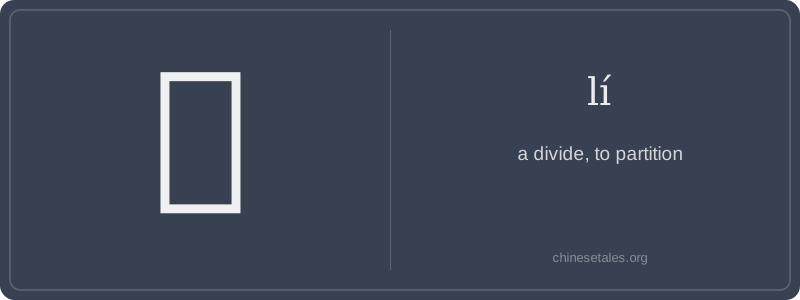
The earliest form of 劙 appears in bronze inscriptions as a compound: a phonetic element ‘利’ (lì, ‘sharp’) fused with a knife-shaped glyph (刂). But look closer — in oracle bone script precursors, the left side wasn’t just ‘利’; it was a stylized depiction of *two parallel lines being severed by a downward stroke*, evoking bamboo stalks or grain bundles cut mid-stem. Over centuries, the top part simplified into the modern ‘利’ (with 禾 + 刂), while the right-side knife radical (刂) hardened into its unmistakable vertical blade — no flourish, just function. By the Han dynasty, the character had stabilized into its current 19-stroke form: sharp, asymmetrical, and visually assertive.
This evolution mirrors its semantic journey: from concrete agricultural act (splitting reeds for weaving or roofing) to abstract legal and philosophical division — Confucian commentators used 劙 to describe the ‘cleaving’ of moral principles from chaos, and Tang poets invoked it when describing mountains ‘cleaving the clouds’ (劙云). The character’s visual tension — the dense, busy left side versus the stark, singular knife on the right — perfectly embodies its meaning: complex material met with decisive, singular force. Even today, seeing 劙 feels like hearing the *shink!* of steel meeting wood.
Let’s get real: 劙 (lí) isn’t just ‘to divide’ — it’s *to cleave*, *to split apart with force*, like hacking through bamboo with a sharp blade. It carries visceral weight, implying a clean, decisive, often physical severance — not gentle separation like 分 (fēn), but a deliberate, almost violent partition. You’ll rarely hear it in casual speech; it lives in classical texts, literary prose, and technical or legal contexts where precision and finality matter.
Grammatically, 劙 is a transitive verb that takes a direct object — always something tangible and resistant: 劙竹 (lí zhú, 'split bamboo'), 劙开木板 (lí kāi mù bǎn, 'cleave open a wooden plank'). Unlike 切 (qiē) or 割 (gē), which can be used for cooking or abstract concepts, 劙 resists metaphorical softening. Learners sometimes mistakenly use it where 分 or 拆 (chāi) would fit — e.g., saying *‘lǐ fēn’* instead of *‘lǐ kāi’* — but 劙 never means ‘to share’ or ‘to disassemble gently’. It’s the linguistic equivalent of slamming a hatchet down on a log: one motion, no negotiation.
Culturally, 劙 echoes ancient craftsmanship and ritual precision — think of carving oracle bones or splitting ceremonial wood for ancestral rites. Its rarity today makes it a subtle marker of literary sophistication. A common pitfall? Misreading its radical (刂, the ‘knife’ radical) as mere decoration — but here, it’s the engine: every stroke serves the idea of *cutting action*. And yes — despite its complexity, it’s not in HSK, so you won’t see it on exams… but you *will* spot it in poetry, historical novels, or when your Chinese friend dramatically declares they’ll 劙开迷雾 (‘cleave through the fog’) to reveal truth.