劘
Character Story & Explanation
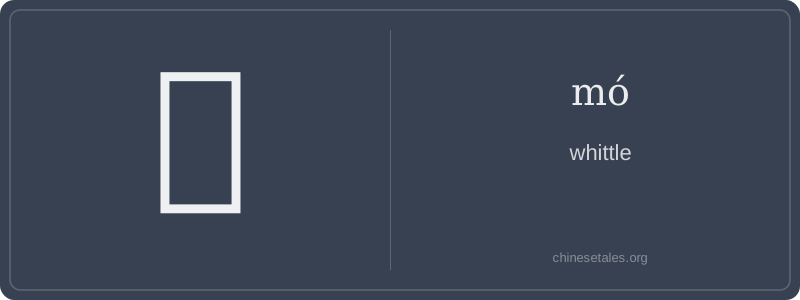
Oracle bone inscriptions show no trace of 劘 — it’s a later invention, first appearing in bronze script during the Warring States period. Its structure reveals its origin: the left radical is 麻 (má, ‘hemp’), not ‘cloth’ as sometimes misread, but referencing the fibrous, layered texture of hemp stalks — material easily peeled or shaved. The right side is 磨 (mó, ‘grind’), itself composed of 石 (stone) + 磨 (repeated). So 劘 was literally conceived as ‘hemp-layer grinding’ — visualizing the act of stripping tough outer layers with controlled abrasion. Over centuries, the hemp radical simplified from ⺮+林 to 麻, and the grinding component condensed into the modern right-hand form.
This layered etymology directly shaped its meaning evolution. In early texts like the *Huainanzi*, 劘 described physical erosion — wind 劘石 (mó shí, ‘whittling stone’). By the Tang dynasty, poets like Du Fu used it metaphorically: ‘dust 劘 heart’ (尘劘心, chén mó xīn) — the slow wearing away of clarity by worldly grime. Its visual duality — hemp’s fibrous strata + grinding’s persistence — made it perfect for expressing subtle, irreversible change. Even today, 劘 feels ancient not because it’s old-fashioned, but because its shape still whispers of hemp stalks being carefully stripped under a scholar’s knife.
At its core, 劘 (mó) evokes the slow, deliberate, almost meditative act of whittling — not just cutting wood, but shaving away layer after layer to reveal a truer form beneath. In Chinese, this isn’t a casual verb like ‘cut’ or ‘chop’; it’s literary, precise, and often metaphorical — implying refinement through persistent, careful removal: of flaws, pretense, excess, or even ignorance. You won’t hear it in daily chats about slicing cucumbers; you’ll find it in essays on moral cultivation or classical poetry describing how time 劘尽年华 (mó jìn nián huá) — ‘whittles away the years.’
Grammatically, 劘 is a transitive verb that almost always appears with a direct object and often pairs with intensifiers like 尽 (jìn, ‘to the very end’) or 去 (qù, ‘away’). It rarely stands alone: 劘平 (mó píng, ‘whittle smooth’), 劘蚀 (mó shí, ‘erode gradually’), or 劘荡 (mó dàng, ‘wear down by repeated friction’). Learners mistakenly treat it like 切 (qiē) or 削 (xiāo), but 劘 implies cumulative, fine-grained action — think sandpaper, not a knife.
Culturally, 劘 reflects the Daoist and Confucian reverence for gradual self-cultivation: virtue isn’t imposed, but revealed by patiently removing what obscures it — like whittling rough bark off a scholar’s bamboo writing brush. A common error? Using 劘 where 磨 (mó, ‘grind, rub’) fits better — but while 磨 suggests friction and effort, 劘 carries an aesthetic of precision and quiet erasure. It’s the difference between grinding coffee beans and carving a jade seal: same energy, vastly different intention.