劖
Character Story & Explanation
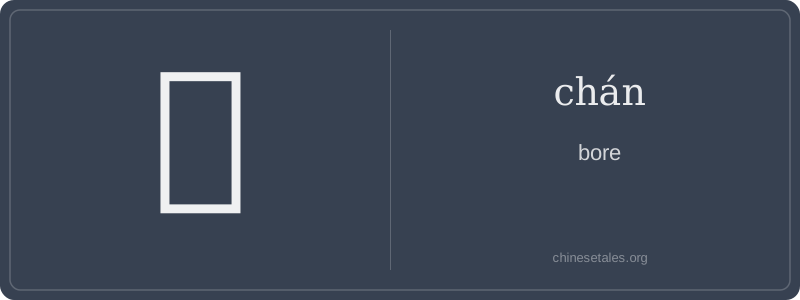
The earliest form of 劖 appears in late Warring States bamboo slips as a composite: a phonetic element ‘毚’ (chán, originally depicting a cunning hare — hinting at agility and piercing focus) fused with the knife radical 刂. Visually, it’s not a pictograph of a drill, but a conceptual fusion — the hare’s quick, penetrating leap + the cutting edge. Over centuries, the top ‘毚’ simplified from a detailed hare head and legs into the modern stacked strokes (⺈ + 冄), while 刂 remained unmistakably sharp and vertical — a blade held steady for precision entry.
This visual logic shaped its semantic path: from ‘the agile act of piercing’ → ‘to bore/drill’ → later extended to ‘to engrave deeply’ or ‘to carve with persistence’, as seen in Tang dynasty inscriptions describing temple stone carvings: ‘劖崖为龛’ (bored into the cliff-face to make niches). The character never drifted into abstract or emotional territory — unlike 禅, which absorbed Buddhist stillness, 劖 stayed stubbornly tactile, material, and mechanical — a testament to China’s ancient engineering ethos.
Let’s be honest: 劖 (chán) is a rare, almost ghostly character — it doesn’t haunt your HSK flashcards, but it *does* haunt classical texts and technical dictionaries. Its core meaning ‘to bore (a hole), to drill’ isn’t about boredom (that’s 百无聊赖), but about the physical act of penetrating with precision — like a craftsman boring into jade or an engineer drilling into bedrock. It carries weight, intention, and force — not idleness.
Grammatically, 劖 functions almost exclusively as a verb in literary or formal contexts, often paired with tools (钻、凿) or materials (木、石、玉). You’ll rarely hear it in speech — instead, modern Mandarin uses 钻 (zuān) or 凿 (záo). For example: ‘他用铁锥劖石为槽’ (He bored a groove into the stone with an iron chisel). Notice how 劖 appears without objects in classical brevity — no ‘-le’ or aspect particles — just pure, compact action.
Culturally, 劖 reflects ancient craftsmanship reverence: boring wasn’t destruction — it was *creation through penetration*, enabling water flow, joinery, or ritual carving. Learners often misread it as 禅 (chán, ‘Zen’) due to identical pronunciation and similar stroke density — a hilarious mix-up that turns ‘he bored the beam’ into ‘he meditated on the beam’. Remember: 劖 has a *knife radical* (刂) — it’s sharp, not serene.