劓
Character Story & Explanation
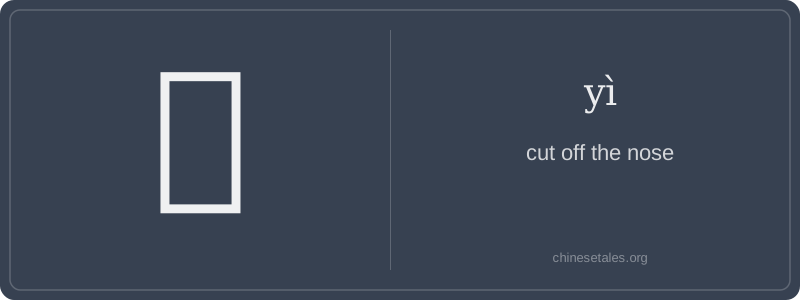
The earliest form of 劓 appears on Western Zhou bronze inscriptions as a compound pictograph: on the left, a stylized nose (自 zì — which originally *meant* ‘nose’, before becoming ‘self’), and on the right, a knife (刂). In oracle bone script, the ‘nose’ element resembled a nostril-and-bridge profile, while the knife was a sharp, downward stroke — together, they screamed ‘knife-to-nose’. Over centuries, the nose component evolved from 自 into 彑 (a variant with a curved top), then simplified to the modern 彑-like top of 劓, while the knife radical 刂 solidified on the right — preserving the violent, unilateral action in every stroke.
This character first appears in the Book of Documents (《尚书》), describing punishments meted out by legendary rulers like Yu the Great. Confucius himself referenced the Five Punishments — including 劓 — not to endorse them, but to contrast ancient severity with ritual-based governance. Interestingly, the visual logic remains unbroken: the top 彑 suggests the head/nose region, the middle 田 hints at containment or ‘the area to be acted upon’, and the final 刂 delivers the decisive cut. Even today, seeing 劓 feels like watching a slow-motion execution — not because it’s gory, but because its structure forces you to trace the violence step-by-step.
At its core, 劓 (yì) isn’t just ‘cut off the nose’ — it’s a visceral, almost archaic verb that evokes the brutal precision of ancient Chinese penal law. Unlike modern verbs like ‘cut’ (切 qiē) or ‘remove’ (切除 qiēchú), 劓 carries irreversible moral and social weight: in early China, nose-amputation was one of the ‘Five Punishments’ (五刑), designed not merely to injure but to permanently mark shame — because a mutilated face could never re-enter polite society. You’ll never hear this word in daily speech; it lives only in classical texts, historical analysis, or scholarly discussions of legal evolution.
Grammatically, 劓 is a transitive verb requiring a direct object (e.g., 劓其鼻 — ‘amputate his nose’), and it almost never appears without explicit reference to the body part or person. Learners sometimes misread it as a noun or try to use it like a modern verb (e.g., *劓了 — ‘he got nose-cut’), but it doesn’t take aspect particles (了, 过) naturally — it’s frozen in literary syntax. Its passive force is so strong that even in translation, English must choose between ‘was subjected to nasal amputation’ (legal tone) or ‘had his nose sliced off’ (graphic tone).
Culturally, 劓 reveals how deeply the Chinese worldview linked physical integrity with moral standing — the face wasn’t just skin; it was social currency. Modern learners often overlook this symbolic gravity, treating 劓 as a mere vocabulary curiosity. But its rarity is precisely the point: its survival in dictionaries is a quiet monument to how law, shame, and visibility were once inseparable — and why a single character can hold the echo of an entire justice system.