劐
Character Story & Explanation
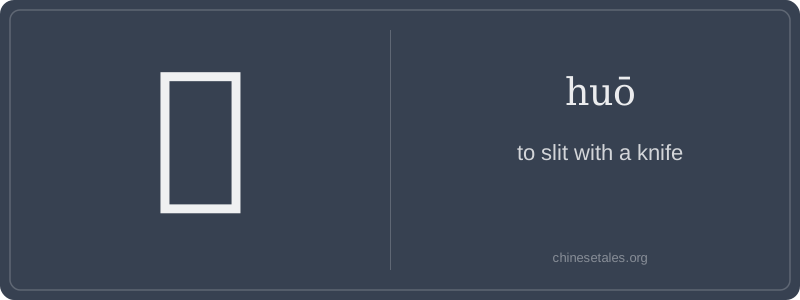
The earliest form of 劐 appears in Warring States bamboo slips as a compound pictograph: on the left, a simplified depiction of a hand holding a knife (later evolving into the ‘害’ component), and on the right, the 刂 (knife) radical. The ‘害’ part wasn’t originally about harm — it represented a *blade pressing down on a target*, with the top stroke suggesting downward pressure and the lower ‘宀+口’ hinting at containment or a surface being breached. Over centuries, the left side standardized into the modern ‘害’, while the right sharpened into the definitive 刂 — turning the whole character into a visual metaphor: ‘a knife acting upon something vulnerable’.
This visual logic held firm across dynasties. In the Shuōwén Jiězì (121 CE), Xu Shen defined it as ‘cutting open with a knife’, citing its use in ancient rites where sacrificial animals were precisely slit to examine internal signs. By the Tang, poets used it metaphorically — Li Bai wrote of ‘slitting open the clouds’ (劙云) to evoke piercing clarity. Even today, the shape whispers its meaning: 15 strokes — just enough for tension, precision, and finality.
Think of 劐 (huō) as the *sound* of a knife slicing cleanly through something — not hacking, not chopping, but that sharp, decisive *shhhk!* of a blade parting fabric, skin, or paper. It’s visceral and precise: it implies intention, control, and a single, clean motion. You’ll rarely see it in daily spoken Mandarin (hence its absence from HSK), but it’s vividly alive in literature, medical texts, martial arts descriptions, and even modern slang like 劐开 (huō kāi) — 'to slash open' a stubborn situation.
Grammatically, 劐 is almost always a verb, often transitive and frequently paired with directional complements (e.g., 劐开, 劐破) or measure words like ‘一刀’ (yī dāo — 'one knife-stroke'). Unlike generic verbs like 切 (qiē, 'to cut'), 劐 emphasizes the *suddenness*, *sharpness*, and *linear force* of the incision. Learners sometimes misread it as huò (like 货), but here the tone is firmly first-tone huō — imagine the sharp exhale of a swordsman making the cut.
Culturally, 劐 carries subtle intensity: in classical texts, it appears in surgical or ritual contexts (e.g., dissecting sacrificial animals); today, writers use it for dramatic effect — think of a character ‘slitting open’ a letter, a silence, or even a lie. A common mistake? Confusing it with 划 (huá/huà) — which is about dragging or drawing lines, not penetrating. 劐 doesn’t graze; it *enters*.