劄
Character Story & Explanation
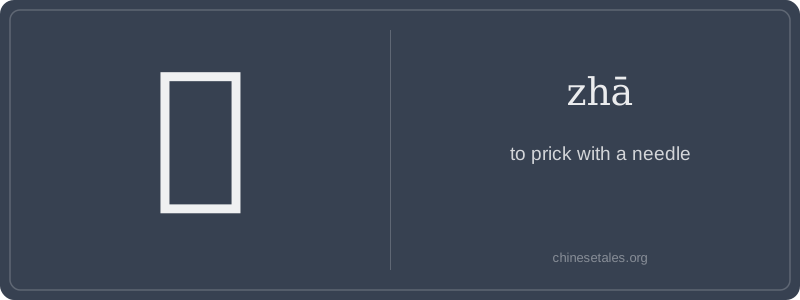
The earliest form of 劄 appears in Han dynasty bamboo slips as a compound ideograph: the top ⺮ (bamboo) radical representing the needle’s material (ancient needles were often bamboo or bone-tipped), and the bottom 酉 (yǒu), originally a pictograph of a wine vessel but repurposed here for phonetic value — though 酉 later shifted to sound like zhā in certain dialects and literary readings. Over centuries, the lower component simplified from 酉 to 乍 (zhà), then stabilized as 乍 with added dots and strokes to distinguish it — resulting in today’s 14-stroke form where the three short diagonal strokes on the right evoke needle points piercing downward.
This character first appeared in medical texts like the Huangdi Neijing, describing needle insertion techniques that required minimal tissue disruption — hence 劄’s emphasis on surface-level, controlled pricks rather than deep punctures. By the Tang dynasty, poets used it metaphorically: Du Fu wrote of sorrow 劄心 (zhā xīn — 'pricking the heart'), likening emotional pain to a needle’s sharp, localized sting. The visual logic remains elegant: bamboo (⺮) + a shape suggesting abrupt, pointed action (乍 + dots) = the exact moment a needle breaches skin.
Think of 劄 like the Chinese equivalent of the English verb 'to jab' — sharp, sudden, and slightly aggressive. It’s not gentle acupuncture (that’s 針灸 zhēnjiǔ); it’s the quick, precise, sometimes painful prick of a needle — like accidentally stabbing your finger while sewing or getting a vaccine. In Mandarin, 劄 is almost always transitive and used with objects: you 劄 something (a finger, skin, fabric), never just 'I 劄.' It rarely appears in casual speech today; you’ll mostly find it in classical texts, medical descriptions, or poetic metaphors for sudden emotional stings.
Grammatically, 劄 behaves like other monosyllabic action verbs: it takes aspect particles (e.g., 劄了一下 zhā le yí xià — 'pricked once'), can be reduplicated for lightness (though rare: 劄劄), and pairs naturally with measure words like 下 (xià) or 針 (zhēn). Learners often misread it as zhá (like 咋) or confuse it with 扎 (zhā/zā), but 劄 is exclusively needle-pricking — no 'tying up' or 'stabbing with a knife' here. Its rarity means even advanced learners may never use it actively, but recognizing it helps decode classical passages and nuanced medical jargon.
Culturally, 劄 evokes precision and vulnerability: a single needle puncture bridges body and instrument, pain and purpose. Mistake it for 刺 (cì — 'to pierce/stab') and you lose nuance — 刺 suggests deeper penetration or aggression (刺杀 cìshā = assassination), while 劄 is superficial, fleeting, and tool-specific. Also, don’t assume it’s interchangeable with 戳 (chuō — 'to poke'); 戳 implies blunt force or carelessness, whereas 劄 demands thinness, control, and intention — like a violinist’s bow hair, not a chopstick.