劁
Character Story & Explanation
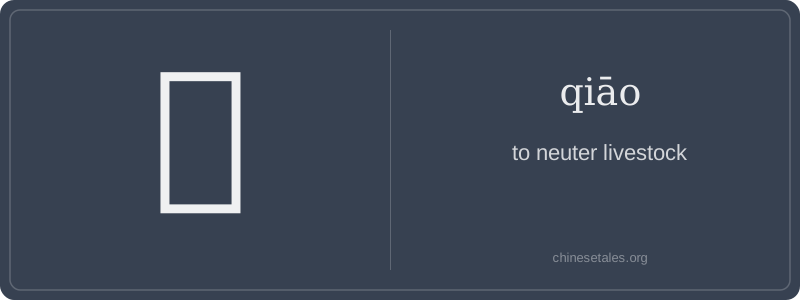
The earliest form of 劁 appears in Han dynasty bamboo slips, not oracle bones — it’s relatively late in the script’s evolution. Its left side, 乔 (qiáo), originally depicted a person with exaggeratedly long hair or a tall hat (亠 + 丿 + 口 + 夭), symbolizing ‘elevation’ or ‘height’ — later repurposed phonetically. The right side is 刂 (the knife radical), unmistakably signaling a cutting action. Over centuries, 乔 simplified from a complex figure into its modern four-stroke form, while 刂 remained steadfastly sharp — the visual fusion literally reads ‘elevated knife’, hinting at a deliberate, elevated (i.e., skilled, ritualized) cut, not haphazard slashing.
This ‘elevated cut’ meaning crystallized during the Ming and Qing dynasties, when livestock management became systematized. Classical texts like the *Complete Book of Agriculture* (《农政全书》) use 劁 specifically for castration — distinguishing it from broader terms like 刳 (to disembowel) or 斫 (to chop wood). Interestingly, the character’s phonetic component 乔 also subtly reinforces intent: in ancient usage, 乔 could imply ‘artificial alteration’ (as in 乔装 — to disguise oneself), making 劁 linguistically echo the idea of purposeful biological modification — not violence, but husbandry-as-craft.
Think of 劁 (qiāo) as China’s linguistic equivalent of a vintage veterinary toolkit — precise, functional, and deeply rooted in agrarian life. It doesn’t mean ‘to cut’ generically (that’s 切 or 割), nor does it carry surgical or metaphorical weight like 刮 (to scrape) or 削 (to pare down). 劁 is laser-focused: to surgically neuter male livestock — pigs, goats, bulls — for better temperament and meat quality. It’s a verb that almost always appears in agricultural reports, vet manuals, or rural policy documents, never in casual speech or modern urban contexts.
Grammatically, 劁 is transitive and typically followed by the animal: 劁猪 (qiāo zhū), 劄羊 (qiāo yáng). Unlike most Chinese verbs, it rarely takes aspect markers like 了 or 过 — you’d say ‘今年劁了二十头猪’ (We castrated twenty pigs this year), but native speakers often omit 了, treating the action as a completed, matter-of-fact farm chore rather than an event with emotional or temporal emphasis. Learners sometimes mistakenly use it for humans (a serious taboo) or confuse it with general cutting verbs — a slip that could turn a farming report into something bizarrely inappropriate.
Culturally, 劁 reflects how Chinese writing preserves hyper-specific pre-industrial knowledge: there’s no single English word that captures its exact semantic niche, and no HSK-level synonym exists. Its rarity outside technical domains makes it a quiet marker of linguistic authenticity — if you know 劁, you’re not just studying Mandarin; you’re reading county-level animal husbandry bulletins from Shaanxi.