劀
Character Story & Explanation
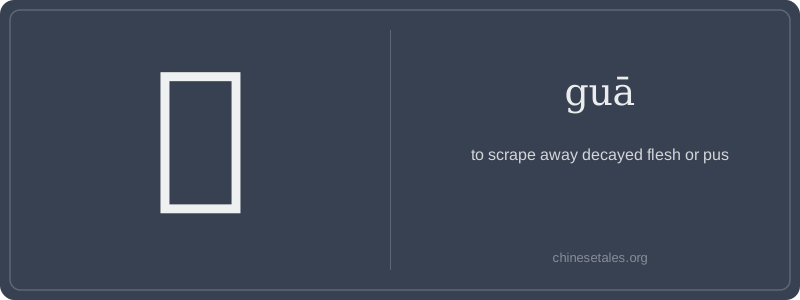
The earliest trace of 劀 appears not in oracle bones but in Han-dynasty medical manuscripts and later seal script forms — where it clearly combines two elements: the radical 刂 (knife/blade) on the right, and a left component that evolved from 古 (gǔ, ‘ancient’) but was graphically simplified and stylized over centuries. In early clerical script, the left side resembled a bent arm holding a tool near a wound — not a pictograph of flesh itself, but of *intervention upon decay*. By the Tang dynasty, the form stabilized into today’s structure: 古 + 刂 — visually encoding ‘ancient knife work’ — referencing time-honored surgical technique, not antiquity per se.
This character’s meaning never wavered: always ‘to cut/scrape away diseased matter’. It appears in Zhang Zhongjing’s *Treatise on Cold Damage* (c. 200 CE) describing wound management, and recurs in Song-era pharmacopoeias specifying ‘劀洗疮口’ (scrape and cleanse sores). Crucially, 劀 never developed extended meanings like 刮 (which branched into ‘to blow’, ‘to stir up gossip’). Its visual austerity — no water, no flesh radical, just blade + ancient — mirrors its semantic discipline: one action, one purpose, zero metaphorical drift. Even today, its form feels like a medical incision — sharp, intentional, and unflinching.
Forget gentle scraping — 劀 (guā) is the scalpel’s first decisive stroke: a visceral, clinical act of removing necrotic tissue or thick, toxic pus. Its meaning carries weight and urgency — this isn’t polishing wood or shaving ice; it’s surgical debridement, rooted in ancient medical practice. In modern usage, 劀 appears almost exclusively in formal, literary, or classical-medical contexts — never in casual speech. You’ll find it in historical texts describing battlefield wound care, TCM diagnostic manuals, or poetic metaphors for moral purification (e.g., ‘刮除心魔’ — though even there, 刮 is far more common). Learners rarely encounter 劀 outside specialized reading — and when they do, they often misread it as the homophone 刮 (guā, ‘to scrape’), missing its precise, clinical gravity.
Grammatically, 劀 functions as a transitive verb requiring a direct object — always something diseased, corrupt, or obstructive: 劀脓 (guā nóng, ‘scrape away pus’), 劀腐 (guā fǔ, ‘remove necrotic flesh’). It cannot stand alone like 刮; you’d never say *‘他用力劀’ — you must say *‘他劀去坏死组织’*. The character also appears in passive or causative constructions: ‘伤口需劀净’ (The wound must be scraped clean). Its rarity means it carries an archaic, almost ritualistic tone — using it in conversation would sound like quoting a Tang dynasty physician.
Culturally, 劀 embodies the Chinese medical ideal of ‘removing the root cause’ (治本) rather than merely alleviating symptoms. Confucian and Daoist texts sometimes borrow it metaphorically — e.g., ‘劀心’ (guā xīn, ‘scraping the heart’) to mean excising selfish desire — but such usage is highly literary and rare. A key mistake learners make is assuming 劀 and 刮 are interchangeable; they’re not. 刮 is broad and neutral (scraping paint, wind刮着脸); 劀 is narrow, urgent, and pathological. Misusing 劀 risks sounding either comically over-medicalized or dangerously imprecise.