剿
Character Story & Explanation
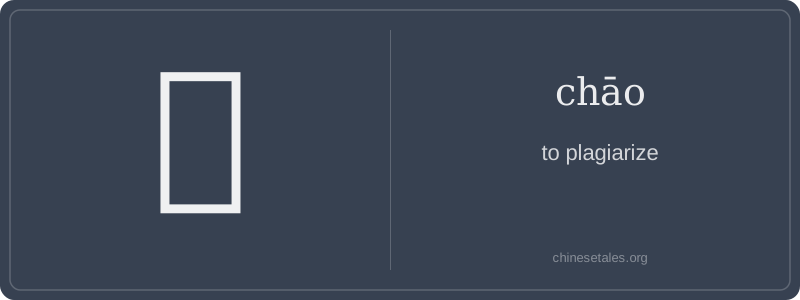
The earliest form of 剿 appears in bronze inscriptions as a combination of 刀 (knife) and 巢 (nest) — not as separate components, but with the knife poised *over* the nest, suggesting violent disruption of a dwelling. Over centuries, the top evolved into the simplified 巛 (a variant of 巢, stylized as three wavy strokes representing nesting layers), while the right-hand 刂 (knife radical) became firmly anchored — emphasizing cutting action. By the Han dynasty, the structure solidified into today’s 13-stroke form: three wavy lines (巛) above a compact 口-like shape (representing containment), capped by the decisive 刂. The stroke order reflects this logic: the upper ‘nest’ is drawn first, then the enclosed space, then the final downward cut of the knife.
This visual metaphor — knife over nest — directly fueled its semantic journey. In ancient texts like the Zuo Zhuan, 剿 (jiǎo) meant 'to wipe out a rebel stronghold', evoking total eradication. But by the Ming-Qing transition, scholars began using it metaphorically: just as a warlord raids and occupies a rival’s fortress, a plagiarist invades and occupies another’s ideas. The shift from physical annihilation to intellectual theft was gradual but potent — cemented in the early 20th century when reformers like Lu Xun condemned 'cultural banditry' using 剿. Today, the knife hasn’t dulled; it’s just pointed at paragraphs instead of palaces.
Imagine a university professor squinting at two student essays side by side — identical phrasing, suspiciously polished citations, even the same typo in paragraph three. She sighs and writes in red ink: '此段涉嫌抄袭' (this paragraph is suspected of plagiarism). That’s 剿 (chāo) in action: not just copying, but *stealthy, deliberate, almost militaristic appropriation* — like raiding another writer’s intellectual territory and claiming it as your own. It carries a strong moral judgment, far sharper than generic 抄 (chāo), which simply means 'to copy'. In practice, 剿 appears almost exclusively in formal, critical contexts: academic integrity reports, journalism ethics statements, or anti-piracy campaigns — never in casual speech ('I copied my friend’s homework' is 抄, never 剣).
Grammatically, 剿 is almost always used as part of the compound 抄袭 (chāoxí), where 剿 reinforces the act’s aggression and illegitimacy. You’ll rarely see it alone — unlike 抄, which can be a verb ('他抄了答案'), 剿 never stands solo. Its tone (chāo, first tone) is crucial: mispronouncing it as cháo (second tone) sounds like 'tide' or 'dynasty', causing total confusion. And while jiǎo exists as an archaic reading (e.g., in classical military texts meaning 'to annihilate'), that pronunciation is functionally extinct in modern usage — so stick to chāo, and only in 抄袭.
Culturally, 剿 reflects China’s deepening emphasis on originality in education and IP law — a relatively recent semantic shift. Historically, it meant 'to exterminate', but by the 20th century, intellectuals repurposed it to condemn intellectual theft with visceral force. Learners often mistakenly write 抄袭 as '抄習' (using 習 instead of 袭) — but 習 means 'to study', so that would literally read 'copy-study', completely missing the violation. Remember: it’s not about learning — it’s about *raiding*.