剽
Character Story & Explanation
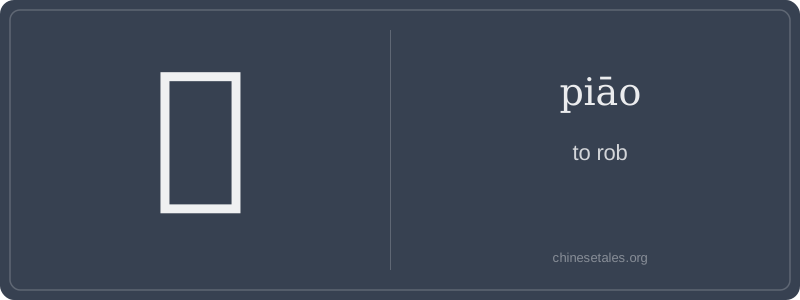
The earliest form of 剽 appears in Warring States bronze inscriptions as a composite: the left side showed a hand holding a weapon (later simplified to 票, representing both sound and motion), while the right was 刀 (dāo, 'knife') — later stylized into the radical 刂 ('knife radical'). Over centuries, the hand-and-weapon element condensed into 票 (piào), a phonetic component that also suggests 'flying' or 'swift action' (like a flying ticket), reinforcing speed and violence. By the Han dynasty clerical script, the shape stabilized: 票 on the left, 刂 on the right — thirteen strokes total, with the knife radical unmistakably signaling physical force.
This visual logic shaped its meaning: not mere taking, but *armed, rapid seizure*. In the Records of the Grand Historian, Sima Qian uses 剽 to describe Xiang Yu’s lightning raids — troops 'flying' in with blades drawn. Later, in Ming dynasty vernacular fiction, 剽 expanded metaphorically: to 'plunder' ideas, styles, or even emotions. Its sharpness never softened — even in modern compounds like 剽窃, the knife remains implicit: plagiarism isn’t borrowing, it’s *cutting and carrying away*.
At its core, 剽 (piāo) isn’t just ‘to rob’ — it’s *sudden, violent, opportunistic seizing*, like a hawk diving or bandits bursting through a gate. It carries urgency and force, never quiet theft: think plundering a camp, snatching documents, or hijacking a narrative. Unlike the neutral 抢 (qiǎng, 'to snatch'), 剿 implies illegitimacy, aggression, and often collective action — you’d 剽 a village in historical texts, not your roommate’s last dumpling.
Grammatically, 剽 is almost always transitive and formal/literary; it rarely appears in spoken Mandarin today. You’ll find it mainly in classical allusions, journalistic metaphors ('plagiarism as intellectual plunder'), or compound verbs like 剽窃 (piāoqiè, 'to plagiarize'). Crucially, it *cannot* take aspect particles like 了 or 过 directly — you’d say 他剽窃了论文 (tā piāoqiè le lùnwén), not 他剽了论文. Learners often overuse it trying to sound 'advanced', but native speakers reach for 抢, 拿, or 偷 instead for everyday contexts.
Culturally, 剽 evokes Warring States chaos or Qing dynasty bandit novels — it’s the word of historians, not cashiers. Its rarity in modern speech makes it a subtle marker of textual sophistication: spotting 剽 in an essay signals the writer’s command of literary register. A common mistake? Confusing it with 飘 (piāo, 'to float') — same sound, opposite energy: one dives with a knife, the other drifts on wind.