剺
Character Story & Explanation
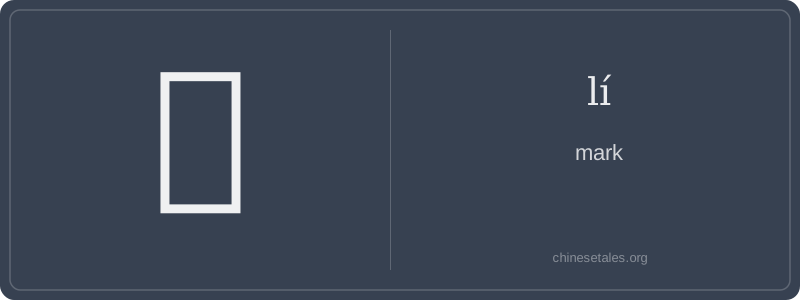
The earliest form of 剺 appears in Warring States bronze inscriptions as a stylized hand holding a sharp tool (like a chisel or knife) pressing into a surface — often depicted with three parallel lines beneath, representing scored marks. Over centuries, the hand (扌 radical) simplified, the tool merged into the right-hand component (利 lì, 'sharp'), and the three lines evolved into the bottom strokes of the modern character. By the Han dynasty, the structure stabilized: left side 扌 (hand radical), right side 利 (sharp), bottom 禾-like base hinting at grain-like grooves — visual echoes of deliberate incision.
This evolution mirrors its semantic journey: from literal physical marking (carving oracle bones, scoring tally sticks) to metaphorical inscription of moral truth. In the Zuo Zhuan, ministers '剺臂为盟' (lí bì wéi méng) — slash their arms to seal an oath — turning bodily marks into unbreakable vows. The character’s very shape — hand + sharp + groove — became a compact philosophy: intention, instrument, and enduring effect in one glyph.
At first glance, 剺 (lí) feels like a ghost character — it’s not in any modern frequency list, doesn’t appear in HSK, and even many native speakers haven’t typed it since middle school. Yet its meaning — 'to mark, to inscribe, to score' — reveals something deeply Chinese: the reverence for deliberate, intentional trace-making. Unlike casual 'writing' (写 xiě), 剺 implies precision, permanence, and sometimes ritual gravity — think carving an oath into bamboo or scoring a boundary line on ancient land deeds.
Grammatically, 剺 is almost exclusively literary and transitive: it *requires* an object (e.g., 剺石 'mark stone', 剺壁 'score the wall'). You’ll never see it alone as a verb in speech — no 'I 剺-ed yesterday'. It appears mainly in classical allusions, historical texts, or poetic compounds like 剺面 (lí miàn, 'to slash one’s face' — an ancient gesture of grief or loyalty). Learners often misread it as lì or líng, but the tone is firmly second-tone lí — like the 'lee' in 'Lee' with a rising lift.
Culturally, 剺 embodies the Confucian-legalist ideal that meaning must be *inscribed*, not just spoken. A contract isn’t binding until it’s 剺 on wood; a warning isn’t real until it’s 剺 on the gatepost. Modern learners stumble by forcing it into colloquial contexts — you wouldn’t 剺 your homework. Its silence in daily life is itself meaningful: some truths are too solemn for texting.